Industry estimates indicate subtractive machining discards 50% to 90% of purchased metal, inflating unit costs as volumes move beyond pilot runs. With steel and stainless prices fluctuating, excessive material waste further drives up costs through tooling wear, longer machining cycles, and repeated secondary operations.
If you oversee engineering or procurement, you likely juggle margin pressure, inconsistent lead times, and suppliers optimized for prototypes rather than production. Every late part risks line stoppages, while fragmented vendors multiply handoffs, inspections, and accountability gaps.
In this blog, we’ll explore how metal manufacturing companies differ by process economics, volume suitability, and quality controls that protect margins. We will also outline selection criteria for 2026 and preview categories where powder metallurgy delivers repeatable parts with fewer supply risks.
Key Takeaways:
Not all metal manufacturing companies serve the same role, making process fit more important than brand recognition for OEM sourcing decisions.
Scrap rates and secondary operations often drive higher costs than quoted pricing once production volumes increase.
Powder metallurgy supports small-to-medium components at scale by reducing material waste and stabilizing production outcomes.
Design for Manufacturability decisions made early can prevent cost escalation during volume ramp-up.
Clear boundaries around part weight, volume, and material family reduce supplier mismatch and delivery risk.
How OEMs Should Evaluate Metal Manufacturing Companies
U.S. manufacturing output continues shifting toward domestic suppliers as OEMs reduce exposure to long transit times, tariff uncertainty, and offshore quality variation. But local sourcing alone does not protect margins if processes remain material-intensive or poorly matched to production volume.
Before comparing vendors, it helps to break the evaluation into a focused set of criteria that directly affect cost-per-part, delivery reliability, and sustained production stability:
Manufacturing economics: Assess material waste, scrap rates, tooling amortization, and secondary operations that influence true cost-per-part beyond quoted pricing.
Process suitability: Confirm whether machining, powder metallurgy, casting, or fabrication aligns with part geometry, tolerances, and annual volume expectations.
Volume scalability: Verify the supplier’s ability to maintain dimensional consistency when moving from hundreds of parts annually to sustained high-volume production.
Quality assurance: Review certifications, inspection methods, and controls used to manage density, tolerances, and batch-to-batch repeatability.
Supply chain structure: Evaluate whether the supplier can deliver finished or assembly-ready components without reliance on multiple external vendors.
Lead-time predictability: Determine how production scheduling, tooling ownership, and inventory programs support consistent delivery without line interruptions.
To apply evaluation logic correctly, you must first understand how metal manufacturing companies differ by role, process, and production focus.
Categories of Metal Manufacturing Companies in the USA
Metal manufacturing companies are often grouped together, yet their roles, cost structures, and production strengths differ widely. Understanding these categories helps OEMs avoid mismatched suppliers that perform well at one scale but struggle at another.
The sections below outline the primary categories OEMs encounter when sourcing metal components, each serving a distinct operational purpose.
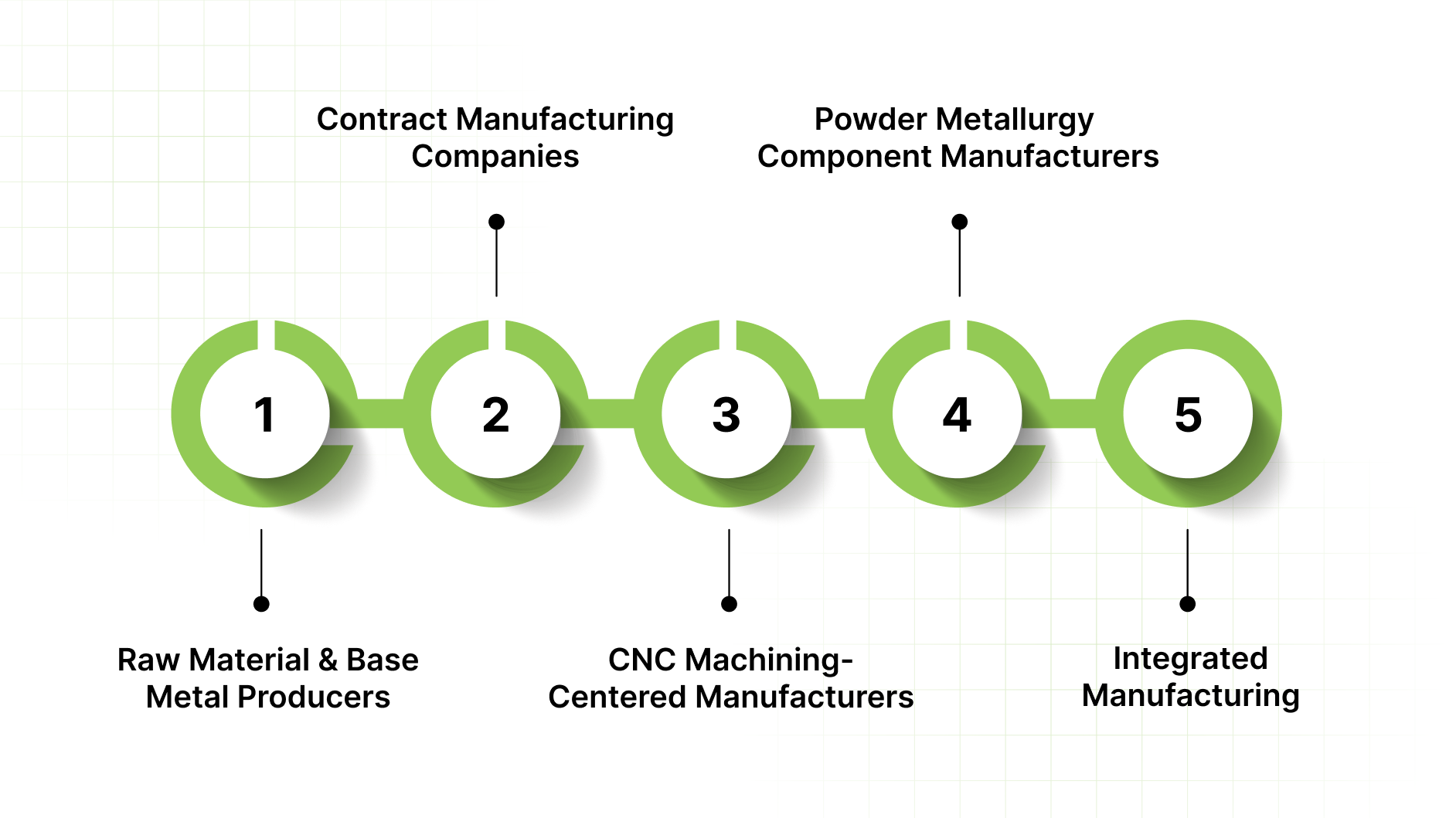
Raw Material and Base Metal Producers
These companies focus on melting, refining, and rolling metals into sheets, bars, coils, and structural forms. Their value lies in supplying large quantities of base material rather than finished, tolerance-critical components.
General Fabrication and Contract Manufacturing Companies
Fabrication-focused suppliers specialize in cutting, bending, welding, and assembling metal structures. They support frames, housings, and weldments but often rely on downstream machining for tight tolerances or complex internal features.
CNC Machining-Centered Manufacturers
Machining-driven companies remove material from solid stock to achieve final dimensions. They perform well for low-to-moderate volumes and frequent design changes but face rising costs as scrap, tool wear, and cycle times increase.
Powder Metallurgy Component Manufacturers
Powder metallurgy specialists form parts by compacting metal powders into near-final shapes before sintering. This category supports high-volume production of small-to-medium components with consistent geometry and controlled material usage.
Integrated Manufacturing and Assembly Providers
These suppliers combine fabrication, finishing, and sub-assembly under one organization. Their primary value is reducing vendor count by delivering components ready for installation rather than individual processed parts.
Understanding these classifications provides context for comparing top metal manufacturing companies without forcing mismatched capability comparisons.
Top 9 Metal Manufacturing Companies in the USA (2026)
Leading U.S. metal manufacturing companies support OEMs in fundamentally different ways, depending on whether the requirement is raw material supply, fabrication scale, or precision component production. A clear comparison requires structured evaluation across process focus, production role, and OEM applicability.
The table below summarizes prominent U.S. metal manufacturing companies in 2026 and the specific manufacturing role each plays within OEM supply chains:
Company | Core Manufacturing Role | Primary OEM Use Case |
Sterling Sintered Technologies | Powder metallurgy components | High-volume, precision mechanical parts |
Nucor Corporation | Steel production | Structural and flat-rolled steel supply |
Steel Dynamics | Steelmaking and recycling | Automotive and infrastructure steel |
Reliance Steel & Aluminum | Metals distribution and processing | Multi-material sourcing and processing |
United States Steel Corporation | Integrated steel production | Heavy industry steel requirements |
Commercial Metals Company | Rebar and construction steel | Infrastructure and construction supply |
Cleveland-Cliffs | Vertically integrated steel | Automotive-grade steel programs |
Boston Metal | Alternative steelmaking | Long-term low-carbon sourcing |
Magrathea Metals | Non-traditional metal sourcing | Electrification-driven material research |
To clarify operational relevance, the following sections outline each company’s manufacturing focus, strengths, and ideal OEM applications.
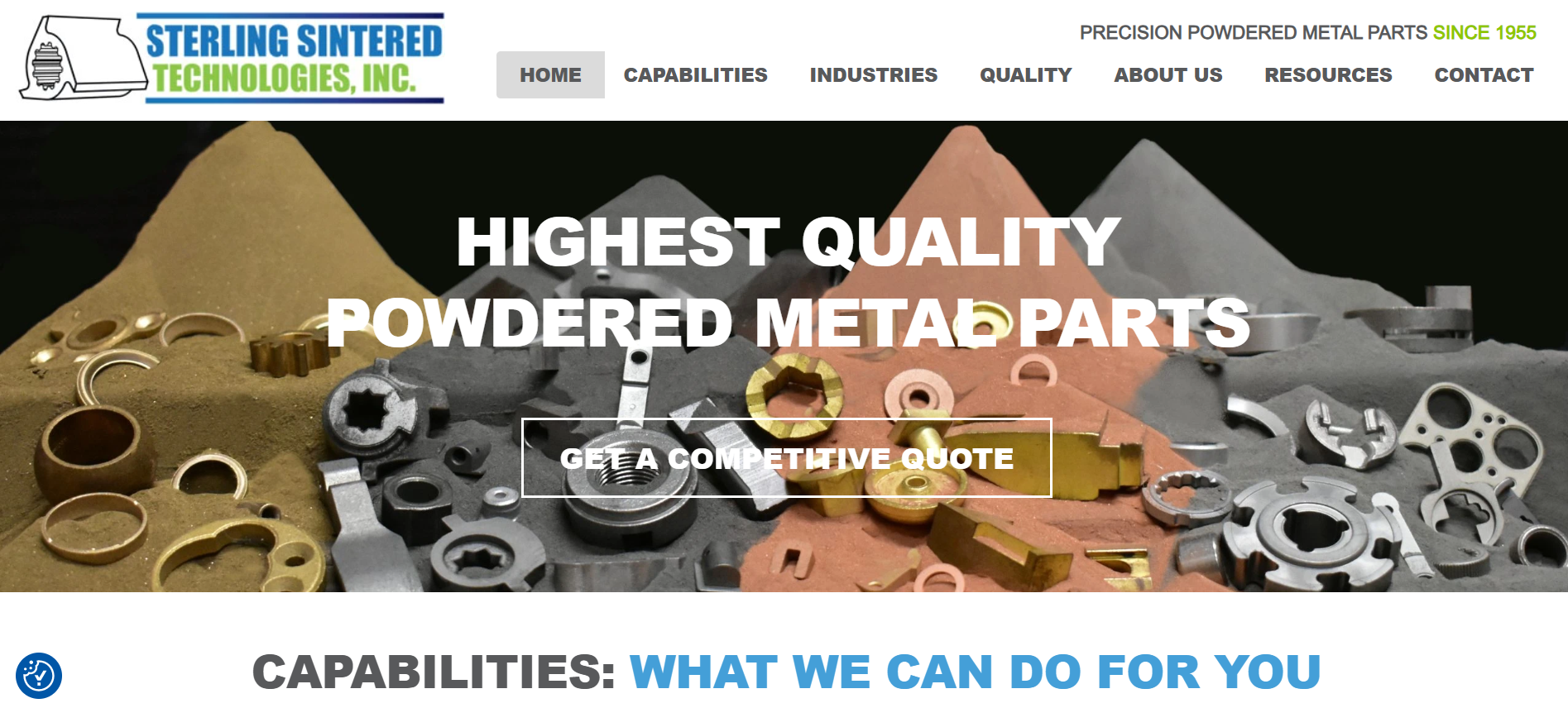
Sterling Sintered Technologies specializes in high-precision powder metal components for OEMs that require repeatability at scale. Rather than acting as a simple parts supplier, the company functions as a technical manufacturing partner focused on long-term production programs.
Key features and services:
End-to-end powder metal manufacturing: Manages the full production lifecycle from manufacturability consultation through tooling, pressing, sintering, and final delivery.
Net-shape and near-net-shape capability: Produces parts with minimal material waste, helping OEMs reduce machining steps and overall cost per component.
In-house PM tooling design and fabrication: Designs and builds compacting dies internally, improving dimensional control and reducing lead times for new programs.
High-volume production scalability: Supports production runs ranging from 500 parts annually to 500,000 parts weekly for established OEM programs.
Multi-level compacting for complex geometries: Enables production of intricate shapes such as splines, gears, and internal features that are costly to machine.
Design for Manufacturability support: Works directly with customer engineering teams to refine part geometry for powder metal processing.
Comprehensive secondary operations: Provides heat treatment, machining, plating, grinding, sizing, oil impregnation, and surface finishing.
Single-source manufacturing model: Delivers assembly-ready parts by managing all finishing processes internally or through vetted partners.
Assembly and sub-assembly services: Supplies functional modules rather than loose components, reducing customer labor and handling time.
ISO 9001 certified quality system: Maintains documented quality controls focused on repeatability and batch consistency.
Nucor Corporation
Nucor Corporation supplies bulk steel materials to OEMs that depend on consistent availability for large production programs. The company focuses on material supply rather than finished component manufacturing.
Key features and services:
Electric arc furnace production: Supplies sheet, plate, bar, and structural steel through domestic melt operations.
High material availability: Supports automotive and construction programs requiring steady supply volumes.
National distribution network: Serves OEMs needing regional material access.
Steel Dynamics
Steel Dynamics combines steel production with scrap recycling to support industrial and infrastructure manufacturing programs. The company emphasizes domestic supply reliability.
Key features and services:
Vertical integration model: Combines steelmaking with recycling and downstream processing.
Flat-rolled and structural steel supply: Supports transportation, energy, and infrastructure markets.
Domestic production footprint: Provides predictable material access for U.S. manufacturers.
Reliance Steel & Aluminum
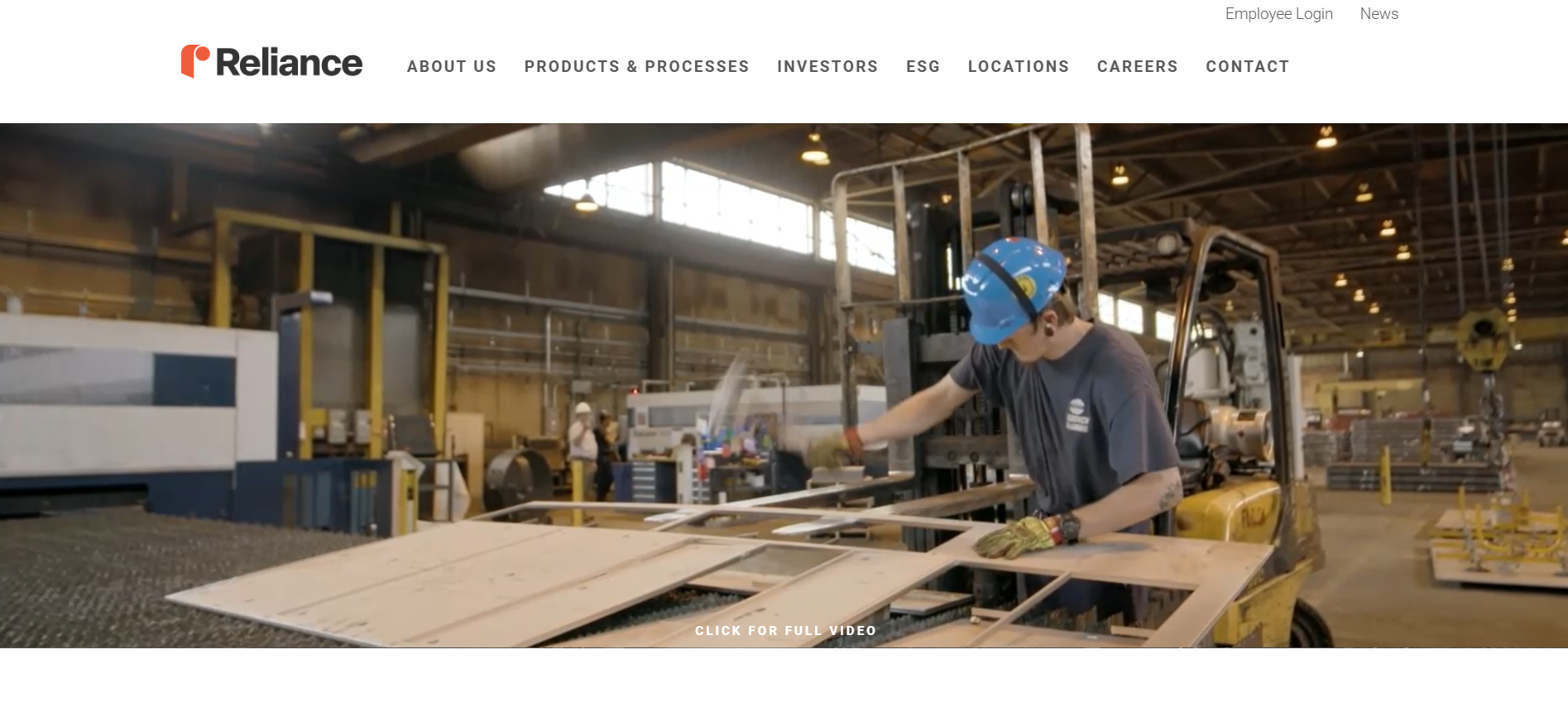
Reliance Steel & Aluminum operates a nationwide network focused on rapid regional metal supply. OEMs use Reliance when speed matters more than custom component manufacturing.
Key features and services:
Nationwide service centers: Delivers regional access to diverse metal forms.
Shorter regional lead times: Supports OEMs requiring fast local delivery.
Broad product assortment: Supplies bar, plate, and specialty metals.
United States Steel Corporation

United States Steel Corporation supplies standardized steel grades for heavy industrial applications. The company focuses on large-scale material production rather than part-level manufacturing.
Key features and services:
Primary steelmaking operations: Produces standardized steel grades at scale.
Energy and industrial focus: Supports infrastructure and heavy manufacturing programs.
Domestic production base: Serves customers requiring U.S.-based sourcing.
Commercial Metals Company
Commercial Metals Company serves construction-driven markets rather than component manufacturing programs. Their offerings focus on structural materials.
Key features and services:
Rebar and merchant bar production: Supplies materials for commercial construction projects.
Fabrication services: Supports regional construction supply chains.
Structural steel specialization: Limited focus on precision components.
Cleveland-Cliffs
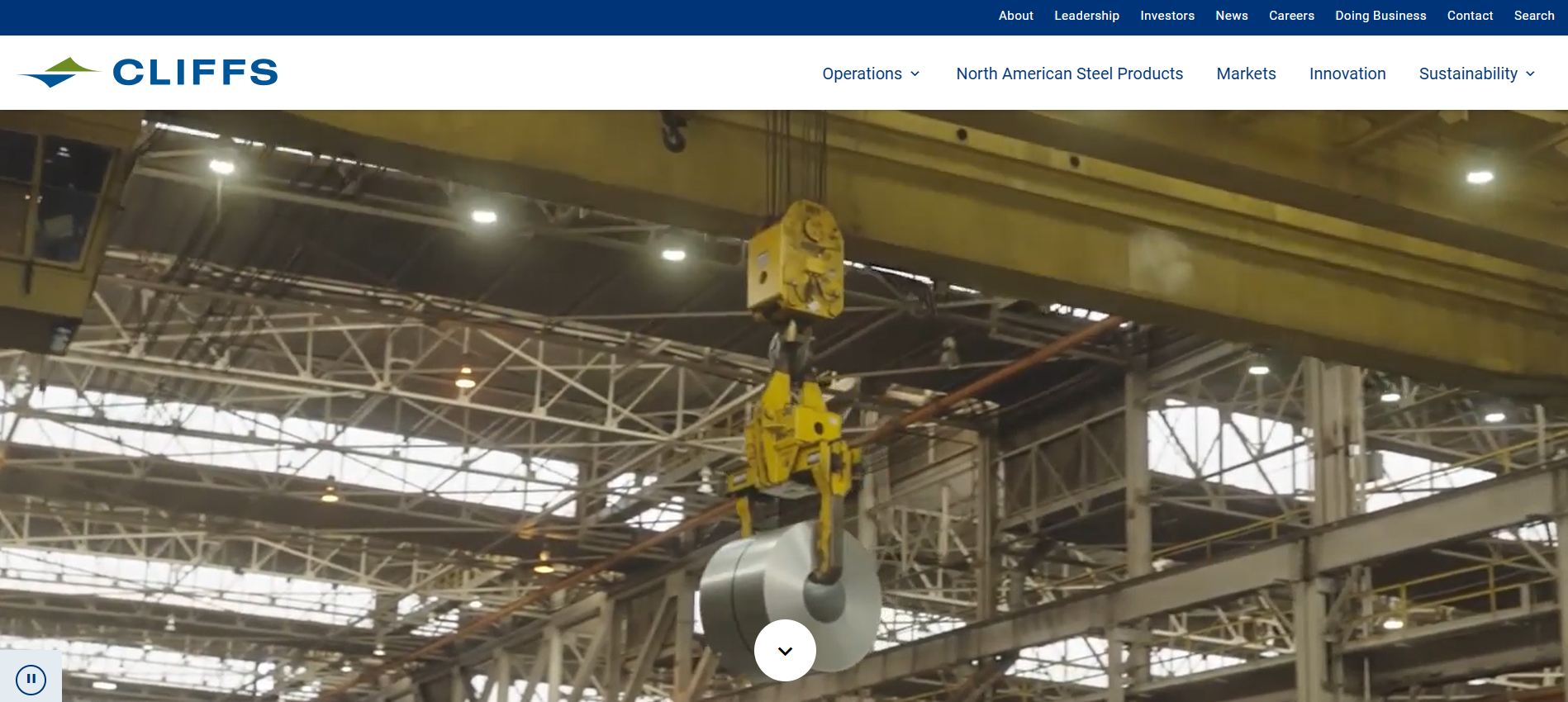
Cleveland-Cliffs controls production from raw iron ore to finished steel products. The company serves OEMs that require traceability and domestic sourcing.
Key features and services:
End-to-end steel production: Controls upstream and downstream operations.
Automotive sheet focus: Supplies manufacturers needing traceable material.
North American footprint: Supports domestic manufacturing programs.
Boston Metal

Boston Metal focuses on alternative steelmaking technologies rather than commercial-scale production. OEM engagement centers on future sourcing strategies.
Key features and services:
Alternative process research: Develops emissions-reduction steelmaking methods.
Future sourcing alignment: Works with OEMs planning sustainability goals.
Technology development focus: Not a high-volume supplier.
Magrathea Metals

Magrathea Metals explores metal production methods outside traditional mining. Their work supports long-term electrification strategies.
Key features and services:
Mining-free metal production: Explores alternative sourcing pathways.
Research-driven programs: Supports early-stage industrial projects.
Limited commercial scale: Not yet ready for mass production.
Among the listed manufacturers, powder metallurgy specialists stand out where repeatability, material control, and volume stability matter most.
Why Powder Metallurgy Is Gaining Share in 2026
As OEMs face sustained pressure from material costs, labor constraints, and delivery risk, process selection has become a financial decision rather than a technical preference. Powder metallurgy continues gaining share because it aligns production economics with repeatability at volumes where traditional machining exposes hidden cost drivers.
The primary reasons OEMs are shifting toward powder metallurgy in 2026 include the following process-level advantages.
Material utilization: Powder metallurgy converts nearly all raw material into finished parts, avoiding the scrap accumulation common in subtractive machining operations.
Geometry consistency: Pressed components maintain repeatable internal features across large batches, reducing variation caused by progressive tool wear in machining environments.
Cost stability at scale: Once tooling is established, per-part costs remain predictable across long production runs without sensitivity to cycle time increases.
Reduced secondary operations: Near-net shapes often eliminate multiple machining steps, lowering labor exposure and inspection complexity across the supply chain.
Production planning reliability: Tool-based manufacturing supports scheduled output rates that align more closely with Kanban and fixed replenishment models.
Process selection alone does not control cost if part designs are not prepared for manufacturing constraints from the outset.
Where Manufacturability Decisions Affect Cost the Most
For high-volume metal components, most cost decisions occur before production begins, often hidden inside geometry assumptions and process mismatches. Design for Manufacturability determines whether a part enters production with stable economics or accumulates avoidable secondary operations over time.
Understanding where manufacturability decisions influence cost helps OEM teams focus on factors that directly affect repeatability and long-term production stability.

Geometry suitability: Features such as undercuts, sharp transitions, or unsupported walls can force added machining steps that raise cost exposure.
Material behavior: Density requirements, porosity expectations, and alloy selection influence achievable tolerances and downstream processing needs.
Tooling constraints: Press tooling limitations define feature orientation and dimensional control, affecting consistency across extended production runs.
Secondary operations: Early design choices determine whether grinding, drilling, or tapping remains necessary after primary forming.
Volume assumptions: Designs validated at prototype scale may behave differently once production reaches thousands of parts per week.
At Sterling Sintered Technologies, manufacturability consultation focuses on refining engineered designs through PM-specific refinements rather than altering functional intent. This approach supports predictable production behavior and reduces cost escalation across sustained powder metallurgy programs.
Conclusion
Selecting among metal manufacturing companies in 2026 depends on matching process economics, volume requirements, and supply reliability rather than reputation alone. OEMs that align geometry, materials, and production scale with the right manufacturing category avoid recurring scrap, delivery risk, and cost escalation.
For programs requiring small-to-medium precision components at sustained volumes, powder metallurgy offers predictable outcomes when designs are prepared for manufacturability. Clear boundaries around part weight, annual demand, and material families help prevent late-stage surprises during production ramp-up.
If you are evaluating whether an engineered component is suitable for powder metallurgy production, contact us to discuss manufacturability consultation and production fit.
FAQs
Who is the largest producer of metal in the United States?
The largest metal producer in the United States is Nucor Corporation, based on annual steel output and domestic production capacity. Nucor focuses on high-volume steelmaking rather than finished precision components for OEM assemblies.
How long does it typically take to switch a machined part to powder metallurgy?
The transition timeline depends on tooling development, part geometry, and validation requirements, but most conversions require several weeks of upfront engineering and testing before production release.
Are powder metal parts suitable for safety-critical applications?
Powder metal components are widely used in safety-critical applications when density, material selection, and process controls are defined correctly during engineering qualification and production planning.
What factors most often disqualify a part from powder metallurgy manufacturing?
Parts may be unsuitable when weight exceeds typical compacting limits, annual volumes remain very low, or required materials fall outside iron, bronze, brass, or stainless steel families.
How should OEMs compare supplier quotes beyond piece price?
OEMs should compare scrap exposure, secondary processing needs, inspection intensity, delivery consistency, and internal labor impact rather than relying on quoted unit pricing alone.