
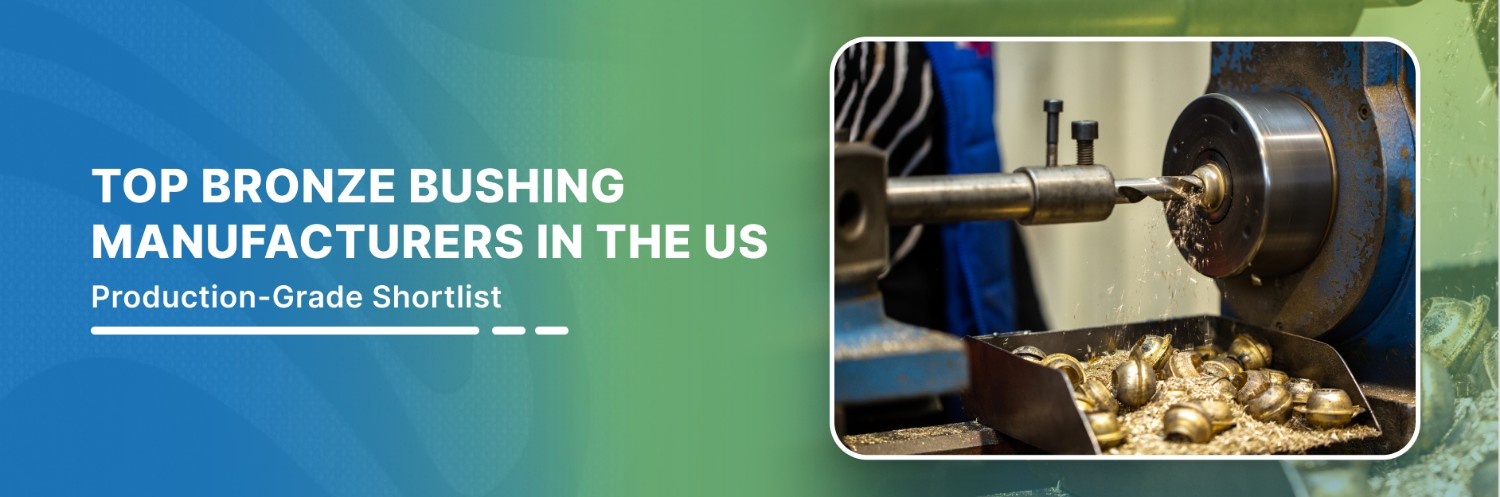
Most “top bronze bushing manufacturers” lists are directories. They do not tell you who will hold fit, friction, and life at production cadence.
For decision-makers like you, the right question is: which supplier can repeatedly deliver the bushing you specified, material, structure, tolerances, lubrication approach, and traceability without downstream surprises.
That includes how they control alloy and microstructure, how they machine and gauge, how they handle oil-impregnation (if applicable), and what they can prove at PPAP/FAI or first runs.
This guide helps you build a short, defensible shortlist of bronze bushing manufacturers and suppliers based on application risk, verification evidence, and supply reliability.
Key Takeaways
“Top” bronze bushing suppliers are defined by repeatability and proof.
Shortlisting works in order: bushing spec/type → manufacturing fit → quality evidence + RFQ controls.
The common failure is buying “bronze bushing” as a commodity, then finding lubrication, porosity, or tolerance drift in production.
A fast screen is process proof + inspection proof + an explicit change boundary.
What “Top Bronze Bushing Manufacturer” Means in a Production Program
“Top” means the supplier that can keep your bushing performing the same way through ramp, steady-state, reorders, and change events without turning receiving, assembly, or warranty into the control plan.
At the production scale, the outcome you are buying is a repeatable function:
Fit stays stable at receiving and after assembly.
Wear life tracks expectations under your duty cycle.
Noise and vibration stay bound under real lubrication and alignment conditions.
Acceptance stays objective, so QA is not forced into a case-by-case debate.
The Five Executive Filters That Define “Top.”
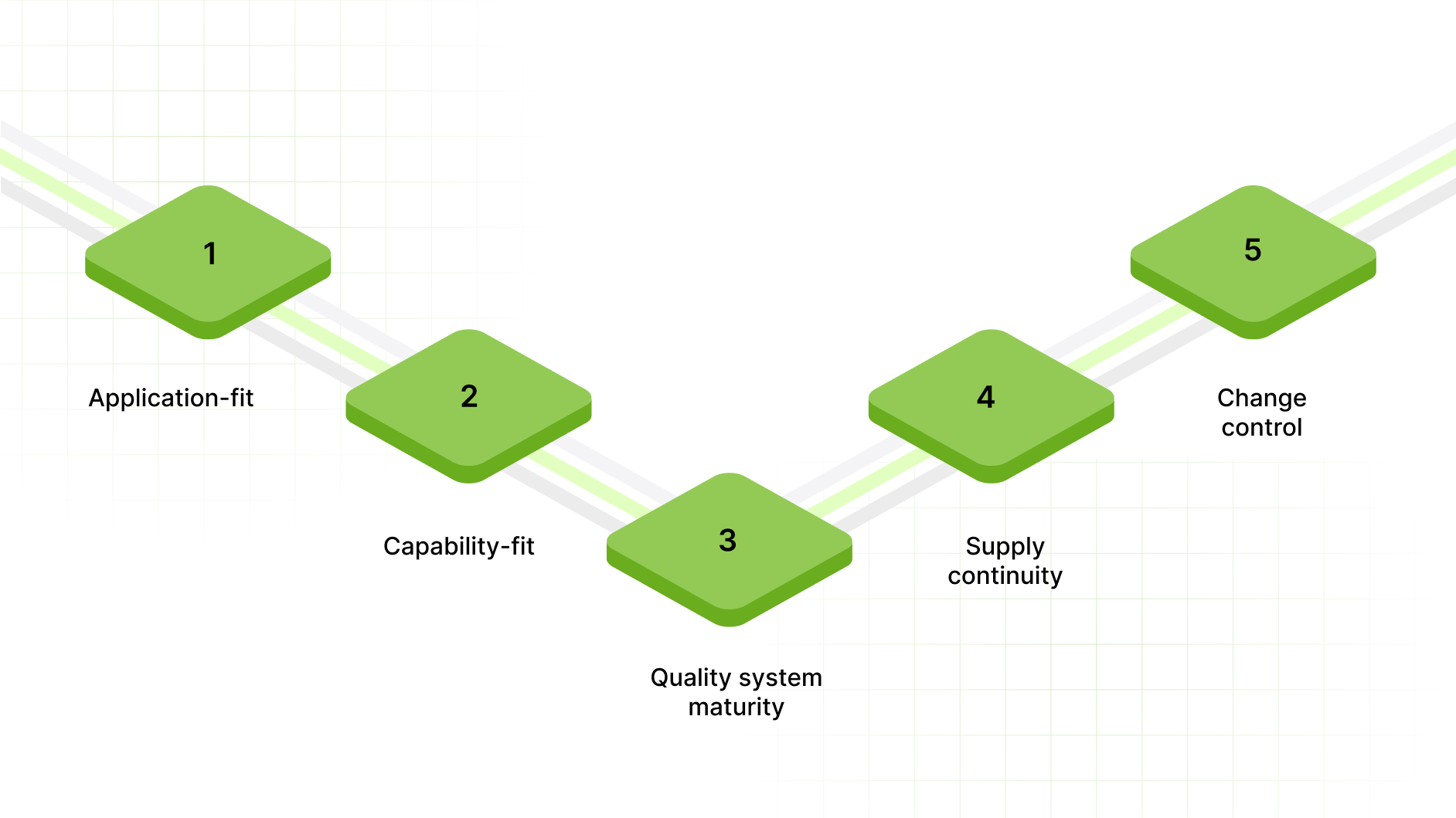
Use these filters before you look at any supplier list.
Application-fit
The supplier’s standard lane matches your real operating window: load profile, surface speed, lubrication regime, contamination, temperature, and duty cycle.
Capability-fit
They can hold the features that matter for your assembly and performance: critical dimensions, ID/OD control, wall consistency, surface condition outcomes, and any secondary operations required to make the bushing “install-ready.”
Quality system maturity
They run a controlled manufacturing system that supports repeatability: documented process controls, traceability, and inspection discipline that scales with volume.
Supply continuity
They can sustain your cadence: lead time stability, capacity planning, material continuity, and a track record of keeping programs supplied during demand swings.
Change control
They treat changes as program events, instead of internal decisions. Process changes, material substitutions, and inspection method changes trigger notification and re-approval before parts ship.
Cost Framing Leaders Actually Use
Unit price is the only variable. At scale, cost shows up in:
Line interruptions and expedited builds
Sorting and rework labor
Scrap from inconsistent press-fit or running clearance behavior
Noise complaints and warranty exposure
Supplier churn occurs when the root cause remains unclear
A “top” supplier reduces these costs by keeping the outcome stable.
The Commodity-Trap Warning Signs
These are early signals that the program is drifting toward avoidable failure:
The spec is broad (“bronze bushing”) with no bounded duty cycle
Lubrication expectations are unclear (initial lube, relube interval, dry-start tolerance)
You lack defined performance outcomes (wear life expectation, allowable noise, acceptable fit drift)
You have no agreed-upon evidence expectations, so capability becomes a debate after parts arrive
The Decision Sequence Used In The Rest Of This Article
Bound the bushing spec to the operating window → screen suppliers for manufacturing fit → require objective evidence → lock controls in the RFQ.
Specify the Bronze Bushing Before You Shortlist Suppliers
“Top supplier” comparisons break down fast when different vendors are quoting different assumptions. Lock the bushing definition first. Keep it to the minimum set that makes quotes comparable and performance predictable.
Application Constraint Set
These inputs determine the bushing lane. Without them, “bronze bushing” becomes a commodity guess.
Load profile: static vs dynamic, peak loads, shock events, misalignment sensitivity
Surface speed: rpm and effective sliding speed at the ID
Duty cycle: Continuous vs intermittent, starts/stops, dwell time, expected life target
PV reality: Use PV as a screen only if your supplier can show how it is derived for your case
Shaft details: Hardness range, surface finish target, coating/plating if any, runout expectations
Lubrication regime: Oil-impregnated/self-lube, grease, oil feed, dry-start tolerance, relube interval
Contamination exposure: Dust, abrasives, chips, moisture ingress
Temperature window: Steady-state and peaks, heat soak, thermal cycling
Material And Build Lanes At A Decision Level
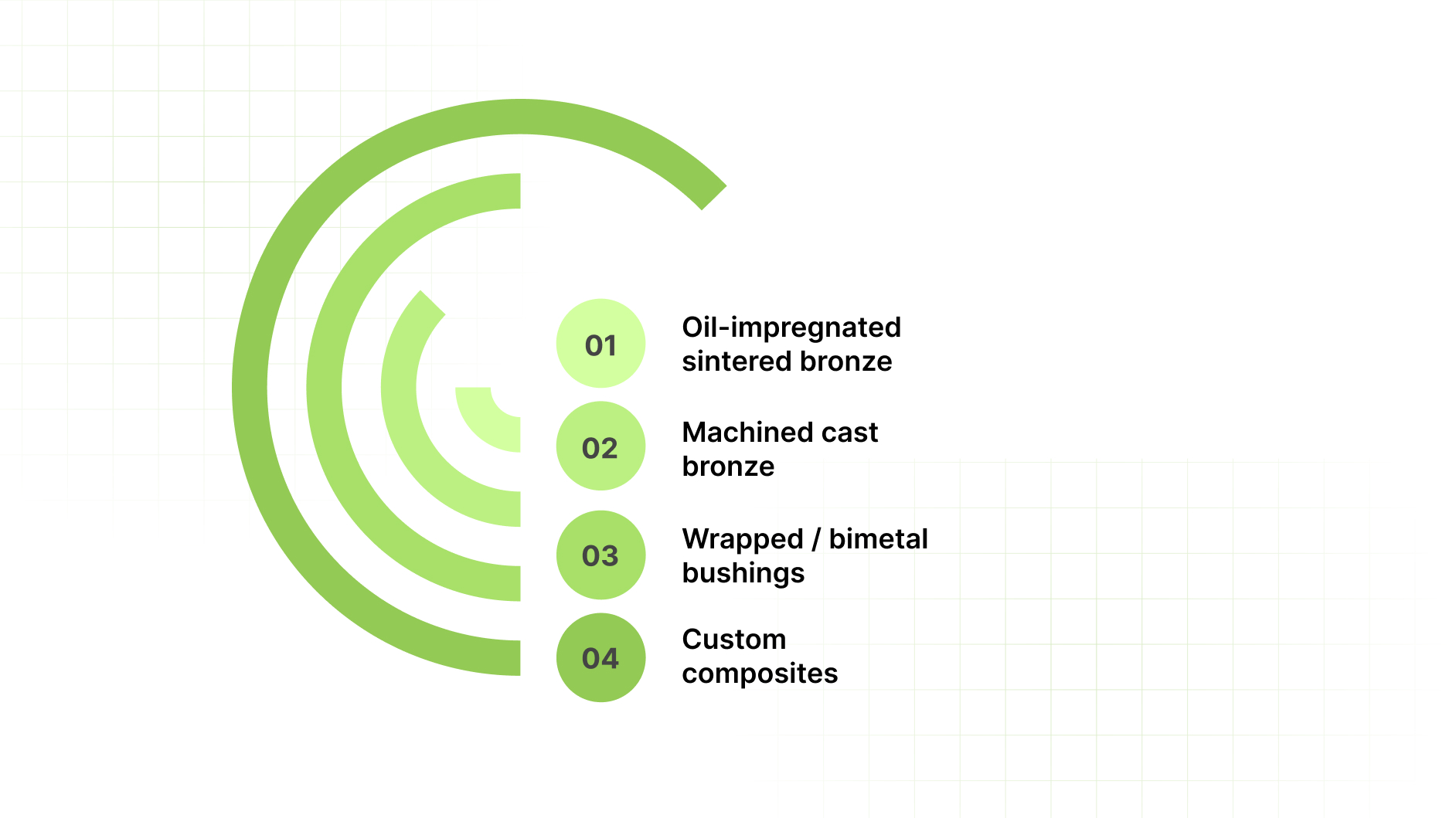
Here, you need a lane decision, so suppliers quote the same architecture.
Oil-impregnated sintered bronze
Best when you need controlled lubrication behavior and a consistent high-volume supply in a defined operating window.
Machined cast bronze
Best when loads, shock, or temperature push beyond typical porous/self-lube expectations, and you want material strength and robustness as the driver.
Wrapped / bimetal bushings
Best when packaging is tight, volumes are high, and a low-friction layer is part of the system design.
Custom composites
Consider when corrosion, chemical exposure, strict “no grease” rules, or extreme duty cycles make standard bronze lanes hard to defend.
Tolerance, Realism, and What Is Truly Finish-Critical
Supplier quotes become misleading when tolerances are set without acknowledging press-fit and operating clearance behavior.
Define the finish-critical dimensions: ID/OD, wall thickness, flange thickness/flatness, length, lead-in/chamfers if assembly depends on them.
Decide what must be checked as-made versus after press-fit:
ID after press-fit often matters more than ID “on the bench.”
If ID after press-fit drives performance, your inspection plan must reflect that (gauging method and condition), even if you keep the drawing tight.
Identify any concentricity/coaxiality expectations that affect noise, wear, or shaft life.
Operating Environment Flags That Change The Lane
They materially change what “best” looks like.
Corrosion risk: Humidity, salt air, condensation cycles, wet storage
Washdowns/cleaners: Alkaline cleaners, solvents, repeated wash cycles
Abrasive dust: Grinding dust, sand, agricultural/field contamination
Chemical contact: Coolants, fuels, process chemicals, degreasers
Packaging/storage reality: Long dwell times, uncontrolled warehouses, high handling frequency
Output Artifact: The One-Page Bushing Definition
Use this as your internal alignment sheet before you contact suppliers.
Application: Load, speed, duty cycle, life target
Shaft: Material/hardness, finish, geometry constraints
Lubrication: Regime, relube plan, dry-start tolerance
Environment: temperature, contamination, corrosion, cleaners
Geometry: ID/OD/length/flange, installation method, press-fit details
Inspection intent: Which dimensions matter after press-fit, and how they will be checked
With the bushing lane defined, supplier selection becomes a capability screen separating true manufacturing fit from catalog reselling.
Manufacturer Capability Checks That Separate Producers From Resellers
You need to answer one question: Can this supplier manufacture the bushing type with controlled operations, or are they reselling a catalog part with limited control over variability?
Lane-Specific “Must-Exist” Capabilities
Bushing Lane | Must-Exist Process Controls | Must-Exist Operations/Equipment | Proof to Ask For (Capability, Not RFQ) | Common “Reseller” Red Flags |
|---|---|---|---|---|
Oil-Impregnated Sintered Bronze | Powder lot control; sinter cycle control; density/porosity targets; impregnation method control; sizing calibration | Sintering furnace capability; sizing/coining; impregnation setup; post-process cleaning/handling controls | Process flow map showing where sizing + impregnation occur; example in-process checks (density/porosity, dimensional after sizing); traceability approach by lot | “We source sintered bushings,” but can’t explain density/impregnation control; no clarity on impregnant type/handling; no sizing story |
Machined Cast Bronze | Alloy/source control (heat/lot); machining stability; burr control; cleaning/flush validation; dimensional gauge control | CNC turning/boring; deburr + wash process; inspection capability for ID/OD/coaxiality; finish-critical surface control | Material cert example tied to lot; sample inspection report for ID/OD + finish-critical features; explanation of wash/deburr validation for your assembly needs | Vague “bronze is bronze” language; no traceable melt/source story; cannot show a stable machining + inspection plan |
Wrapped / Bimetal Bushings | Strip material control; forming control; bond integrity controls; lining thickness/consistency; edge condition control | Forming line; bonding method capability; lining application control; trim/finish control | Sample cross-section data (bond/lining consistency) from prior programs; explanation of how lining thickness is controlled; process flow showing in-house vs subcontracted steps | Only sells catalog part numbers; no bond/lining control narrative; cannot discuss failure modes (delamination, lining variation) |
Custom Composites / Special Environments | Material system definition; thermal/chemical compatibility controls; friction/wear assumptions bounded; manufacturing consistency plan | Defined manufacturing route for the composite system; controlled finishing/fit operations; inspection plan tied to critical interfaces | Prior-case evidence that material choice matches environment; high-level test/field evidence summary; clear statement of what they will and won’t claim | “We can customize anything” without boundaries; no evidence of environment-fit; vague performance claims with no test context |
Hybrid / Secondary-Op Heavy Bushings (grooves, knurls, flanges, ream, oil holes) | Feature repeatability controls; tool wear monitoring; burr + edge condition controls; post-op inspection discipline | Grooving/knurling; flange forming; reaming/honing as needed; deburr + clean; inspection for feature geometry | Example drawings/inspection sheets showing they routinely hold these features; in-process checks for grooves/holes; evidence of fixtures/tooling capability | “Yes, we can do that,” but cannot show prior similar work; no burr-control plan; no post-op cleaning/inspection story |
How to use this capability screen
1) Confirm they match your lane, then force specificity.
If the supplier claims sintered oil-impregnated capability, they should be able to describe where sizing happens, how impregnation is controlled, and what they measure to prevent drift. If they cannot, assume you are dealing with a reseller or a thin control chain.
2) Verify secondary operations readiness early.
Programs fail when core bushings are stable, but secondary features are not. Grooves, oil holes, reamed IDs, flange forming, and deburr/clean steps often drive assembly fallout. If these are in your one-page bushing definition, the supplier should show prior capability on similar features.
3) Look for run-rate and repeatability signals.
Capability is not a single successful lot. Ask how they hold outcomes across reorders: tooling ownership, documented process windows, and evidence that they have run similar parts at production cadence.
4) Treat “red flags” as disqualifiers, not negotiation points.
Generic catalogs, vague statements about lubrication/impregnation, and no traceability story are not minor gaps. They usually show up later as porosity drift, inconsistent friction behavior, or fit variation.
Capability fit is necessary, but it is not sufficient. Before you shortlist, collect three items that confirm the critical steps and release method are controlled.
Evidence To Request Before You Shortlist
Use this to confirm you’re dealing with a controlled manufacturer.
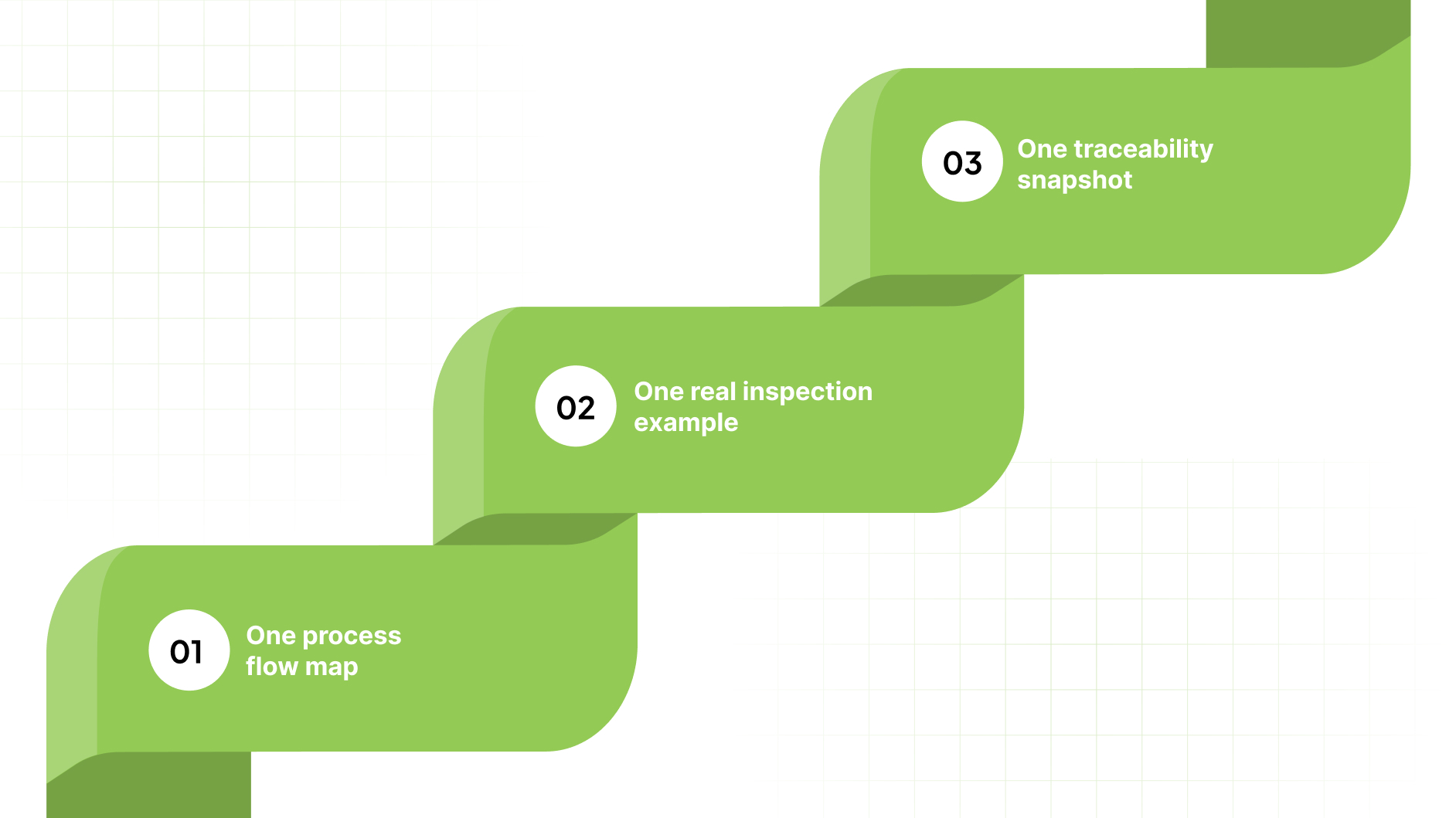
One process flow map showing what is in-house vs subcontracted (and where the critical step happens: sinter + sizing + impregnation, machining + deburr/wash, forming + bonding/lining).
One real inspection example from a comparable part family (ID/OD plus any feature that drives your assembly risk), including the gauging method used.
One traceability snapshot showing how they tie material/lot to production and final inspection (enough to isolate the scope if a lot fails).
Now group suppliers by the lane they are structurally built to run.
A Shortlist of Bronze Bushing Manufacturers and Suppliers, Grouped by What They’re Strong At
This is not a ranked “top 10.” It is a lane-based shortlist. Start with the lane defined in your one-page bushing definition, then use the Best Fit / What to Verify / Watch-Outs prompts to keep comparisons consistent.
Group A: Custom Sintered Bronze Bushings and Powder-Metal Components
Best when you need more than a catalog SKU and want process control tied to repeatability.
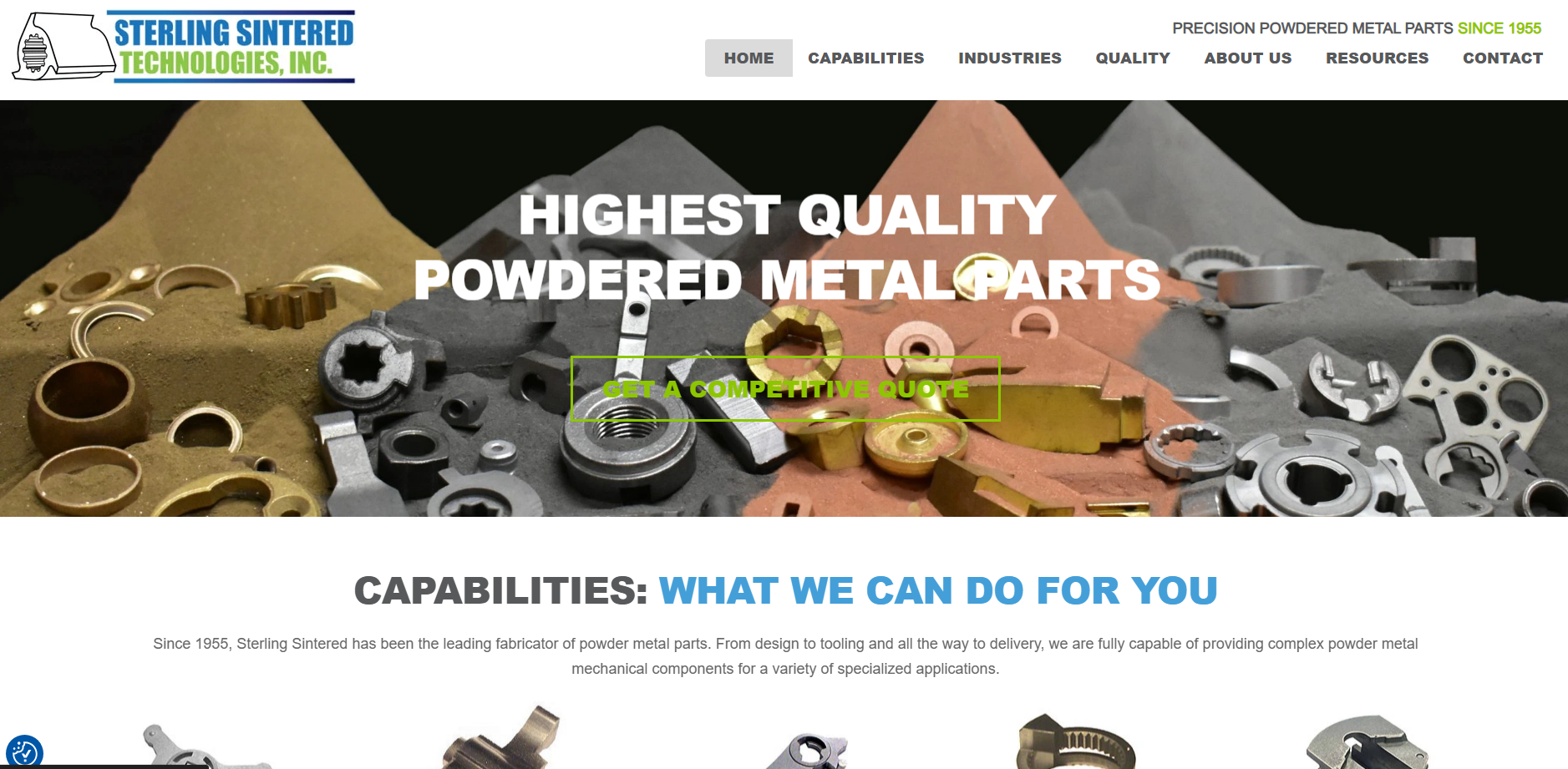
Best fit: Custom powdered-metal manufacturing in bronze and other materials when you need engineered outcomes (geometry, repeatability, traceability) rather than treating “bronze bushing” as a commodity.
What to verify: Which bushing features are controlled in-house for your lane (sizing/finishing features, inspection method for finish-critical dimensions), and how lot-to-lot consistency is maintained at production cadence.
Watch-outs: If your requirement is a standard off-the-shelf bushing with minimal controls, a catalog source may be faster. Sterling is most valuable when repeatability and control reduce downstream risk.
If your program is sensitive to fit drift, lubrication behavior, secondary-feature repeatability, or traceability, Sterling Sintered is often a strong manufacturing-first option in this group because the value is built around controlled powder-metal production rather than directory-style sourcing.
Case study: How Sterling Sintered consolidated multiple components into one powder-metal part
A lock-hardware customer brought Sterling a design that used multiple parts (stampings, pins, and a powder-metal component). After early design involvement, Sterling redesigned it into one complex powder-metal part that arrived with no sub-assembly required and still had to survive a high-torque impact test. Sterling states that the part passed the impact test and that they perform strength tests during manufacturing, with the part passing since launch.
Bunting Bearings
Best fit: Oil-impregnated sintered bronze bushings for self-lubricating applications where standard sizes and a proven sintered bearing lane are a fit.
What to verify: Material/standard alignment (e.g., SAE 841-style requirements), sizing and impregnation controls, and how ID is verified for your assembly condition.
Watch-outs: Many “sintered bushing suppliers” are resellers. Confirm whether you are dealing with a manufacturer or a tightly controlled supply chain.
OILITE
Best fit: Standardized self-lubricating sintered bearings/bushings for programs that want established sintered bearing options.
What to verify: Grade/standard equivalency, oil content/handling expectations, and packaging/storage controls to avoid “dry arrival” disputes.
Watch-outs: If you need nonstandard geometry, special secondary operations, or tighter change control, confirm customization and documentation depth early.
Group B: Machined or Cast Bronze Bushing Specialists
Best when strength/robustness and machining control are the driver, or when porous self-lubrication is not the right architecture.
National Bronze
Best fit: Bronze bearings/bushings and bronze materials where cast/machined bronze options and material selection matter.
What to verify: Alloy/spec match, machining and deburr/clean controls, and how finish-critical dimensions are gauged in the same condition that matters for your press-fit reality.
Watch-outs: “Bronze” is not one material. Require explicit alloy/grade clarity and inspection condition (as-made vs after press-fit).
SC Industries
Best fit: Bronze bushings and bearings supply when you need a known channel that can quote across a range of bronze bushing requirements.
What to verify: Whether parts are manufactured in-house vs sourced, plus traceability and inspection expectations aligned to your receiving checks.
Watch-outs: If your risk is high (noise, wear-life sensitivity, tight clearance), confirm manufacturing control depth, not just availability.
Group C: Wrapped / Metal-Polymer / Bimetal Plain Bearings
Best when the “bushing” is a lined plain-bearing system and you need controlled friction behavior.
GGB
Best fit: Metal-polymer plain bearings with bronze backing for dry or lubricated operation, including corrosive environments (application-fit still governs).
What to verify: Lining/backing architecture fit, operating limits, and how lining consistency is controlled for your duty cycle.
Watch-outs: Do not compare these directly against solid bronze or sintered bronze unless the bearing system and failure modes are explicitly aligned.
Treat these as starting points. Expand your shortlist using reputable directories, then cross-check each supplier against the capability screen mentioned above so you do not mix manufacturers with resellers.
Once your shortlist is set, the fastest way to prevent drift is to lock RFQ and control-plan requirements that keep the delivered condition consistent after award.
RFQ And Control-Plan Requirements That Prevent Bushing Drift After The Award
At this point, you have already bound the bushing, screened capability, and built a lane-based shortlist.
The remaining failure mode is drift after award: the supplier still ships “bronze bushings,” but the delivered condition changes across lots, reorders, or internal substitutions.
1. Lock The Approved Baseline As The Only Shippable Configuration
Attach the one-page bushing definition and make it the governing baseline.
Parts must be produced and shipped to the approved configuration and inspection condition on file. Any deviation requires written approval before shipment.
2. Define A Clear Change Boundary
Require pre-approval for any change that could shift fit, friction, wear life, or receiving acceptance, including:
Moving any critical operation in-house or to a subcontractor (or changing the subcontractor).
Changing the bronze material system, grade, or source.
Changing the lubrication or impregnation approach, or any post-process handling that affects the delivered surface condition.
Changing tooling, sizing/finishing steps, or any operation that controls the fit-critical dimensions you release against.
Changing how parts are measured or accepted, including gages, setups, or the inspection condition used for release.
Changing packaging, preservation, or shipping materials in a way that can affect surface condition, cleanliness, or handling performance at receiving.
No change is considered equivalent unless validated against the same acceptance method used for release.
3. Require Lot-Level Traceability That Enables Fast Containment
Lot and sub-lot identification on packaging and paperwork.
Configuration identification on the certificate (lane + delivery condition).
Containment expectation if a lot fails: the supplier must support back-trace to impacted lots and ship dates, so the scope is isolated quickly.
4. Set Ramp Governance Once, Then Relax By Evidence
First-article approval before first production release
Enhanced early-run checks for an initially defined lot window
Relaxation only after stability is demonstrated at production cadence
5. Request The Two Documents That Prevent Most Disputes
A lot certificate confirming the approved configuration and inspection condition were used
Change notification record when a change-boundary item is triggered
That is enough to keep accountability clean when issues appear months later.
If you are already seeing supplier-to-supplier variation, unexpected wear/noise behavior, or repeated debate at receiving, this governance layer is usually the fastest correction because it stops drift before the next lot ships.
Request a Bronze Bushing Review From Sterling Sintered
If your program is seeing wear variability, noise, press-fit drift, or internal debate about lubrication/impregnation evidence, a short bushing review often costs less than another quote cycle.
Sterling Sintered can help you validate whether your current bushing definition is tight enough to quote consistently and release objectively at receiving, before variability turns into sorting, rework, or repeat supplier churn.
What To Send
Provide a compact packet so the review stays fast and focused:
Drawing and revision level (and any finish/cleanliness constraints).
Load, speed, duty cycle, and life target (including peak/shock events if relevant).
Lubrication reality: self-lubrication vs external lube, relube interval, dry-start tolerance.
Shaft details: material/hardness, surface finish, coatings, runout expectations.
Environment: temperature range, contamination, corrosion risk, washdowns/chemicals.
Fit-critical dimensions and the inspection condition you care about (as-made vs after press-fit).
What You Get Back
A decision-maker output you can use immediately:
Confirmation that the spec is bounded enough to compare suppliers on equal assumptions.
Manufacturability feedback on the fit-critical features and any secondary operations driving risk.
A recommended inspection and traceability approach aligned to how you intend to receive and assemble parts.
A concise list of control boundaries that should trigger re-approval if anything changes.
If the component is sintered metal-based, geometry or performance is sensitive, and repeatability matters more than a lowest-price re-quote, request a bronze bushing review by sending your print and operating constraints to Sterling Sintered.
Conclusion
A “top” bronze bushing supplier is the one who can hold functional fit and bearing behavior at production cadence, with controls that survive reorders and change events.
Use a disciplined sequence:
Define the bushing to your real operating window.
Confirm manufacturing capability for that bushing lane.
Require minimum proof that the critical steps and inspection conditions are controlled.
Build a lane-based shortlist that keeps comparisons consistent.
Lock RFQ and control-plan requirements so the delivered condition does not drift after award.
One avoid: do not buy bronze bushings as a commodity when PV, wear life, noise, or warranty exposure matter. That is where “same part, different outcome” shows up.
Finalize a shortlist and push your RFQ with explicit release and change controls, or request a focused review to validate the bushing lane and release condition before you re-quote.
FAQs
1) What is the difference between SAE 841 and SAE 660 bronze bushings?
SAE 841 is typically oil-impregnated sintered bronze intended for self-lubricating use. SAE 660 is a cast bronze alloy used when strength and machinability are the priority. Treat them as different bearing architectures, not interchangeable materials.
2) When should I avoid oil-impregnated sintered bronze, even if it is commonly used?
Avoid it when you cannot tolerate oil bleed-out, when operating temperatures and cleaning cycles strip lubrication, or when the duty cycle pushes beyond what the porous structure can support without accelerated wear. In those cases, a cast bronze or a lined bearing system is often easier to control.
3) What is a realistic shelf-life expectation for oil-impregnated bronze bushings?
Shelf life is usually limited by packaging, storage conditions, and how oil retention behaves in your environment. If parts sit for long periods, define storage conditions and a re-check rule instead of assuming indefinite stability.
4) What should I do if I need corrosion resistance but still want bronze bearing behavior?
Treat corrosion control as a system decision: environment exposure, housing/shaft materials, and any protective strategy must be aligned without compromising friction and wear. Do not assume “bronze” alone solves corrosion in wet or salt environments.
5) What is the fastest way to identify a supplier change that caused performance drift?
Start with what can silently change outcomes: material source or powder system, impregnation method, sizing/finishing steps, inspection condition, and packaging. If those are not traceable at the lot level, drift becomes hard to isolate and expensive to contain.
6) If I have a field failure, what information should I request to contain the scope quickly?
Ask for lot traceability from raw material/powder through final inspection, the inspection records for the lot, and confirmation of any process or inspection method changes since the last “good” lot. This supports containment without shutting down the full supply stream.