Manufacturing in 2026 doesn’t look like it did even a few years ago. Engineering teams are under pressure to deliver custom parts faster, closer to home, and with zero room for error.
What once worked, slow iterations, fragmented vendors, and cost-first decisions, now creates bottlenecks. Today, the search for the best manufacturing solutions for custom parts production in 2026 is really about finding partners who combine precision, speed, and adaptability.
Whether you’re validating a new design or scaling to production, the right approach can make or break timelines. Below is a curated list of manufacturing companies setting the benchmark for custom parts in 2026.
Key Takeaways
Custom parts production in 2026 is driven by integrated manufacturing ecosystems, where digital platforms, material science, and automation work together instead of fragmented vendor chains.
Powder metallurgy, additive manufacturing, and generative design have become core enablers for producing complex, lightweight, and near-net-shape components with minimal material waste.
Agentic AI and digital twins are now operational tools, enabling autonomous supply-chain planning, simulation-led engineering, and faster design-to-production cycles.
Manufacturers are prioritizing resilience and transparency through near-shoring, multi-region production networks, and real-time production visibility.
The most competitive manufacturing partners in 2026 combine precision engineering, sustainability, and scalable automation, rather than competing on cost alone.
5 Best Manufacturing Solutions for Custom Parts Production 2026
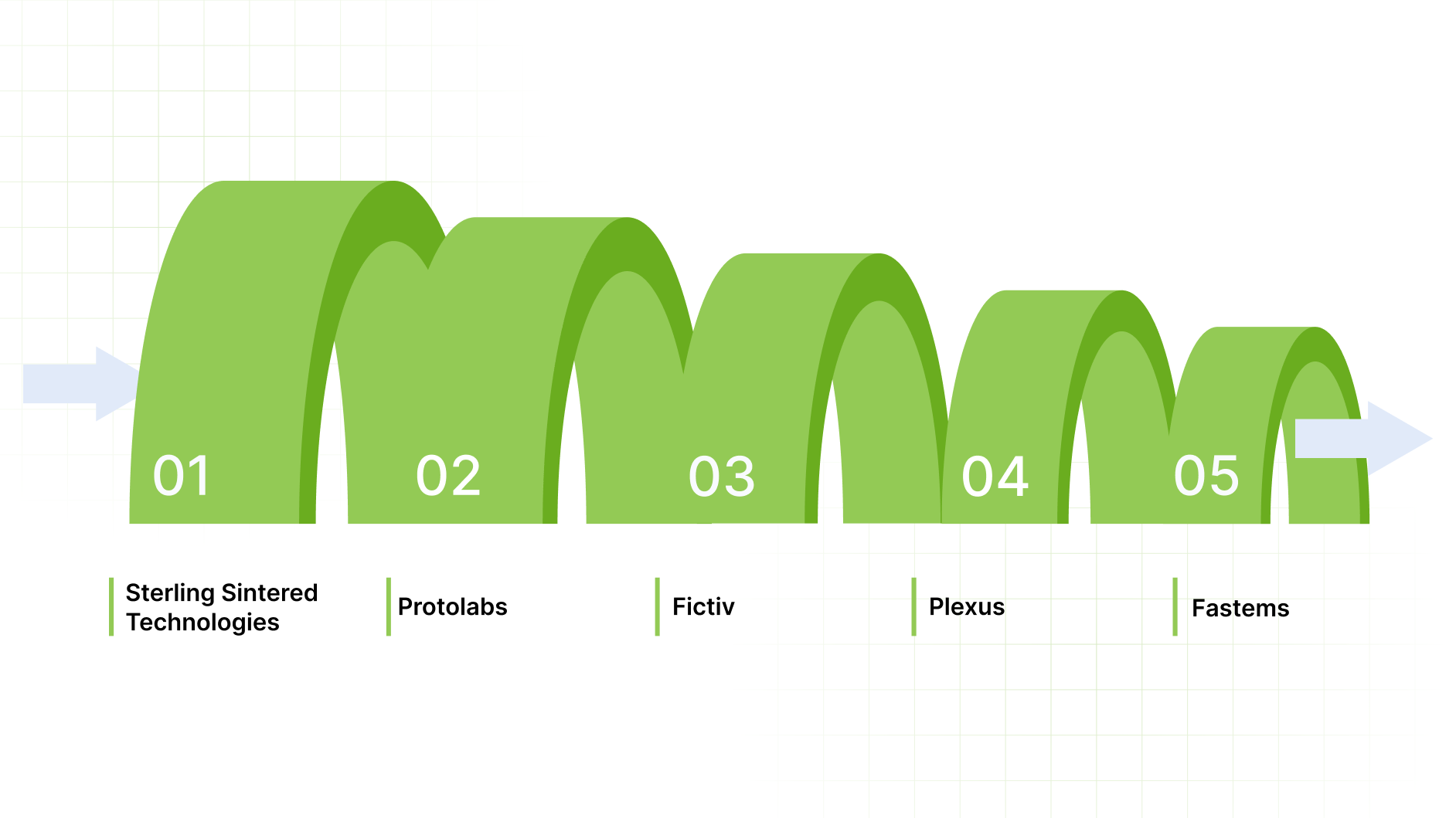
To stay competitive in the current year, businesses are moving away from fragmented vendor lists toward integrated digital platforms and specialized precision partners. Here are the top companies leading the charge in custom parts production for 2026.
1. Sterling Sintered Technologies (SST)
As we look at the most efficient ways to produce complex, high-strength parts in 2026, powder metallurgy (PM) remains a dominant and highly sustainable solution.
Sterling Sintered Technologies stands at the forefront of this technology, offering a "near-net shape" manufacturing approach that minimizes material waste and eliminates the need for extensive machining.
SST specializes in the custom fabrication of powdered metal parts, ranging from miniature components to complex structural elements. Their expertise in metallurgy allows them to work with a wide variety of materials, ensuring that every part meets specific mechanical requirements.
By utilizing high-pressure compaction and controlled-atmosphere sintering, they provide parts that offer superior consistency and durability compared to traditional casting or machining.
Key Features & Services:
Specialized Component Production: High-precision manufacturing of gears and sprockets designed for high-torque applications.
Self-Lubricating Solutions: Production of bearings and bushings with controlled porosity for long-term oil retention.
Advanced Material Selection: Expertise in stainless steel, iron and steel, and bronze alloys.
Comprehensive Post-Processing: Access to critical secondary operations, including oil impregnation, resin impregnation, and specialized machining to meet exact tolerances.
In-house Toolmaking: Custom tool and die design to accelerate the transition from concept to production.
Best For: Industries requiring high-volume, precision components with complex geometries, particularly in the automotive, aerospace, and medical device sectors, where material efficiency and part consistency are non-negotiable.
2. Protolabs
Protolabs remains the "industry-best" for speed in 2026. By operating their own highly automated, digital factories in the United States and Europe, they eliminate the middleman and focus on rapid-turn production.
Their 2026 services have expanded to include more advanced photopolymers and enhanced CNC milling capabilities that accept 2D technical drawings for high-requirement projects.
Key Features & Services:
Digital Thread Integration: An end-to-end digital workflow that moves a design from CAD to shipping in as little as 24 hours.
Automated DFM Feedback: Interactive Design for Manufacturability (DFM) analysis is included in every quote to catch potential issues before the first part is even made.
High-Volume Molding: Capable of producing up to 100,000+ parts with volume pricing and no minimum order quantities.
Metal 3D Printing (DMLS): Advanced additive manufacturing using titanium, aluminum, and stainless steel for complex aerospace and medical components.
Best For: Companies in the "product launch" phase where time-to-market is the primary driver and rapid iteration of functional prototypes or low-volume end-use parts is required.
3. Fictiv
Fictiv has evolved in 2026 into a comprehensive "Digital Manufacturing Backbone." Now part of the Misumi Group, they provide a single source for both custom mechanical parts and standard components. Their focus is on reducing "complexity risk" by integrating precision welding and electromechanical assembly into their digital platform.
Key Features & Services:
Precision Electromechanical Assembly: A unified system for sourcing parts and having them assembled into sub-systems before shipping.
AI-Powered Design Intelligence: Tools like "Auto DFM" for sheet metal and injection molding that provide 3D visualizations of mold flow and gate locations.
Global Production Centers: Manufacturing hubs in India, Mexico, China, and the U.S. that offer "Delivered Duty Paid" (DDP) services for full cost transparency.
Parts Library: A centralized hub for tracking design revisions, reordering, and maintaining organized records for faster supply chain traceability.
Best For: Hardware startups and enterprise innovators who need to move seamlessly from prototype to full-scale assembly without the risk of adding multiple suppliers or overhead.
4. Plexus
Plexus is a leader in the "Design-to-Build" manufacturing space for 2026. They focus on highly regulated sectors such as healthcare, life sciences, and defense.
Unlike pure-play manufacturers, Plexus provides extensive engineering and design services at the front end to ensure parts are optimized for both performance and long-term supply chain stability.
Key Features & Services:
Regulatory Compliance Expertise: Deep experience in meeting FDA, FAA, and MIL-SPEC requirements.
Sustaining Engineering: Services to manage component obsolescence and redesign parts to extend product lifecycles.
Integrated Supply Chain Solutions: End-to-end visibility from sourcing raw materials to final distribution and aftermarket services.
Global Manufacturing Footprint: Large-scale facilities equipped with advanced automation and "lights-out" manufacturing capabilities.
Best For: Organizations in the medical and aerospace industries that require strict adherence to regulatory standards and long-term production partnerships for critical mission-ready components.
5. Fastems
Fastems doesn't just make parts; they provide the "Automation Ecosystem" that allows other manufacturers to run 24/7. In 2026, their Flexible Manufacturing Systems (FMS) are the gold standard for high-mix, low-volume custom parts production. They specialize in "lights-out" CNC automation that maximizes spindle utilization.
Key Features & Services:
Manufacturing Management Software (MMS): Software that acts as the "brain" of the factory, planning production schedules based on actual orders and material availability.
Robotic Finishing Cells: Fully automated cells for deburring, washing, and marking custom parts without human intervention.
Modular Automation: Systems that can grow with a company, starting from a single machine and expanding to a full automated line.
Predictive Maintenance: IoT-connected systems that alert operators before a tool breaks or a machine requires servicing.
Best For: Custom machine shops and internal manufacturing departments looking to achieve maximum efficiency and "lights-out" production for CNC-machined parts.
How to Choose the Right Manufacturing Solution for Custom Part Production?
With so many technologies available from CNC machining and 3D printing to injection molding and powder metallurgy, selecting the right partner can be overwhelming. In 2026, the selection process should be guided by five critical factors:
1. Production Volume vs. Tooling Costs
If you need 10 parts, 3D printing or CNC machining is often the most cost-effective. However, as you scale toward 1,000 or 1,000,000 parts, the cost-per-part becomes the dominant metric.
In these scenarios, processes that require specialized tooling, like powder metallurgy or injection molding, provide significantly lower long-term costs despite the initial investment.
2. Geometrical Complexity and Internal Features
Does your part have internal cooling channels or complex undercuts?
Additive manufacturing (3D printing) excels here. However, if your part is a high-strength gear or a self-lubricating bearing, the unique ability of powder metallurgy to control porosity and combine different alloys becomes the deciding factor.
3. Material Properties and Strength
Not all "custom" parts are equal. A plastic prototype may look like the final product, but it won't survive the torque of an industrial motor. You must match the material to the application.
For high-wear environments, materials like stainless steel or iron and steel alloys provided through sintering offer mechanical properties that often exceed those of cast parts.
4. Precision and Tolerance Requirements
Standard tolerances for custom parts in 2026 are tighter than ever. While CNC machining offers the highest pinpoint precision (down to microns), modern sintering and 3D printing have closed the gap. Consider whether your partner offers secondary operations like specialized machining or resin impregnation to hit those critical final specs.
5. Digital Capability and Transparency
In the age of the "Smart Factory," your manufacturer should be a digital extension of your team. The best partners offer online portals for real-time tracking, automated DFM feedback during the design stage, and API integration into your ERP system for seamless reordering.
Custom Manufacturing Trends for 2026: A Deep Dive
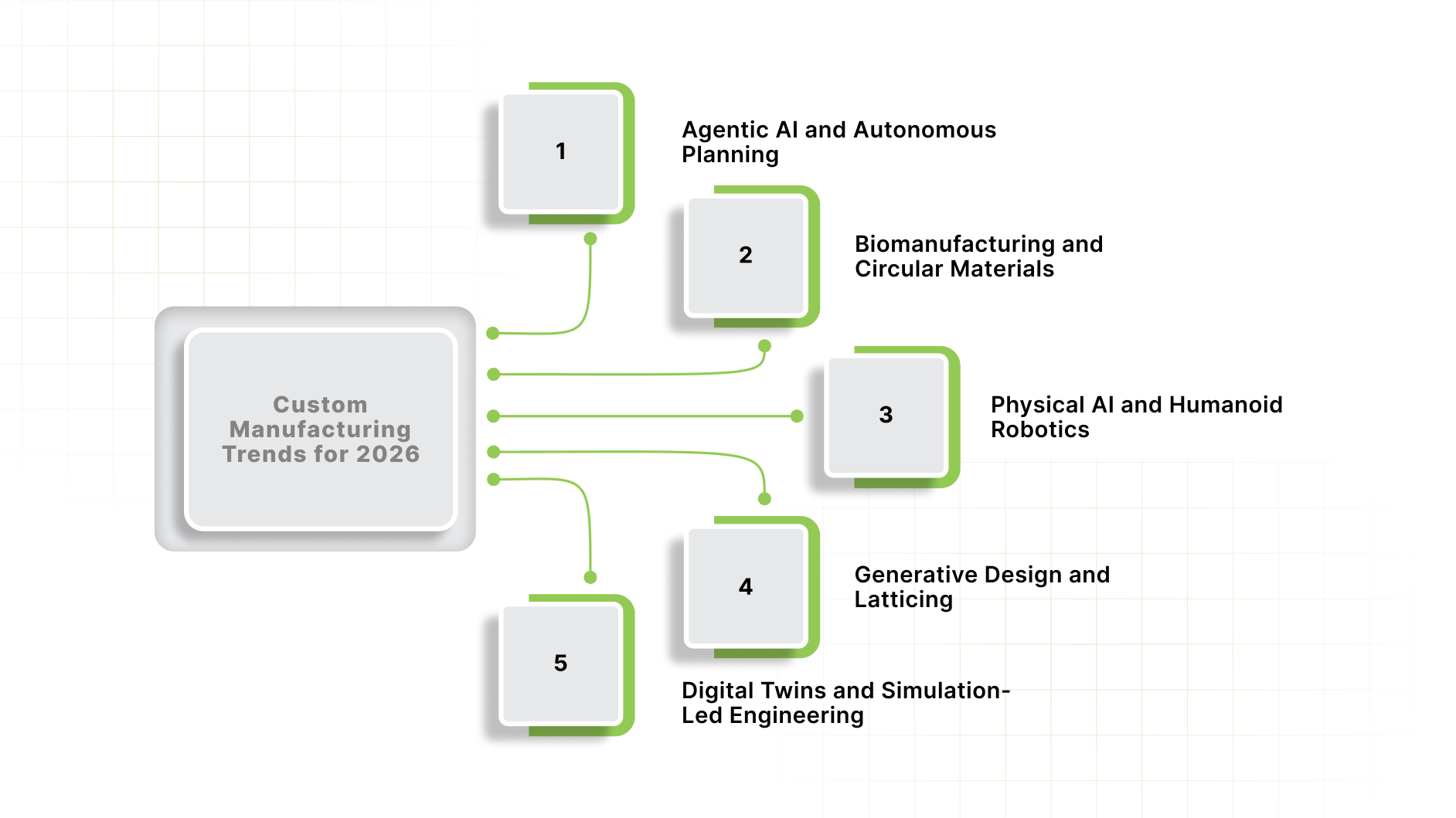
The solutions listed above are powered by a few fundamental shifts in the manufacturing landscape. Understanding these trends is key to choosing the best manufacturing solutions for custom parts production in 2026.
1. Agentic AI and Autonomous Planning
In 2025, we saw AI that could analyze data. In 2026, we have "Agentic AI," software that can not only identify a supply chain bottleneck but also autonomously search for an alternative supplier, negotiate a preliminary price, and present the procurement team with a finished plan for approval.
This level of autonomy is drastically reducing lead times and administrative "red tape."
2. Biomanufacturing and Circular Materials
The demand for sustainable parts has led to the rise of biomanufacturing. Manufacturers are increasingly programming living cells to produce high-performance molecules for resins and polymers, creating a "circular" material economy.
3. Physical AI and Humanoid Robotics
The "talent gap" in manufacturing is being addressed through Physical AI. Robotic dogs and humanoid robots are now traversing unstructured environments like a crowded production floor to transport parts, perform inspections, and even assist in the installation of equipment.
These robots don't replace humans; they handle the "3D" tasks: those that are Dirty, Dull, or Dangerous.
4. Generative Design and Latticing
Generative design has moved beyond a novelty. Engineers now define the performance requirements, such as weight limits and stress points, and AI explores thousands of design possibilities that use the least amount of material.
This has made processes like 3D printing and powder metallurgy even more valuable, as they can produce the complex lattice structures that generative design often requires.
5. Digital Twins and Simulation-Led Engineering
Simulation is no longer a "check" at the end of the design process; it is the driver. Digital twins allow manufacturers to run "what-if" scenarios for years in virtual time within a matter of minutes.
This ensures that when a custom part goes into production, the manufacturing process is already optimized for the highest possible yield and the lowest defect rate.
Conclusion
Finding the best manufacturing solutions for custom parts production in 2026 is about more than just finding a machine shop. It is about identifying a partner that integrates into your digital workflow and supports your goals for sustainability and resilience.
Whether you choose the material efficiency and precision of powder metallurgy from a specialist like Sterling Sintered Technologies, or the global agility of an AI-powered marketplace like Xometry, the key to success in 2026 is flexibility.
The manufacturing world is moving faster than ever. By leveraging agentic AI, embracing sustainable processes, and prioritizing digital transparency, your organization can turn the challenges of 2026 into a competitive advantage.
Ready to streamline your parts production?
Contact Sterling Sintered Technologies today!
FAQs: Custom Manufacturing in 2026
1. What is the most sustainable custom manufacturing process in 2026?
Powder metallurgy (offered by partners like Sterling Sintered) and biomanufacturing are leading the way. Powder metallurgy is particularly sustainable because it uses recycled metal powders and results in almost zero scrap, compared to CNC machining, where up to 60-70% of a block of metal might end up as "chips."
2. How has AI changed custom parts production this year?
AI has evolved from simple data analysis to "Agentic AI." It now handles complex tasks like autonomous supply chain planning, real-time DFM (Design for Manufacturability) analysis, and predictive maintenance, allowing manufacturers to run more efficiently and with fewer delays.
3. Is reshoring still a major trend for 2026?
Yes. Over 70% of manufacturing leaders are focusing on reshoring or "near-shoring" (moving production to neighboring countries like Mexico or Canada). This trend is driven by a need for agility and a desire to avoid the geopolitical risks and high carbon footprints associated with long-distance shipping.
4. What should I look for in a 2026 manufacturing partner?
Focus on three things: Digital Maturity (can they provide real-time data?), Material Expertise (do they have the right alloys or polymers for your specific application?), and Process Transparency (can you track your part through every stage of production?).