Global data show the powder metallurgy parts market will grow from about $26.34 billion in 2025 to $32.96 billion by 2030, driven largely by automotive and aerospace adoption of mass-produced precision parts.
Manufacturing leaders often find it difficult to apply successful prototyping methods once annual volumes surpass the low thousands, leading to costly transitions and uncertainty. While CNC machining offers early accuracy, increasing material waste, cycle time limitations, and rising unit costs pressure profit margins as demand grows.
In this blog, we’ll explore how OEM teams should evaluate precision components manufacturers using production criteria, compare suppliers by manufacturing type, and discuss how powder metal manufacturing achieves repeatable precision at scale.
Key Takeaways:
Precision at scale depends on repeatable processes, not tolerance claims from early production runs.
CNC machining fits low volumes, while powder metal supports stable cost and geometry at higher annual demand.
Manufacturing archetype matters more than supplier size when comparing long-term production fit.
Powder metal manufacturing reduces material waste while maintaining consistent mechanical performance.
Supplier selection should focus on cost behavior, capacity stability, and quality discipline over time.
How OEMs Should Evaluate “Top” Precision Components Manufacturing Companies
Many supplier lists rank manufacturers by tolerance claims or brand visibility, yet these signals rarely predict long-term success once programs reach sustained production volumes and cost pressure increases. For OEM teams responsible for launches, margins, and uptime, the definition of “top” ties directly to predictable performance under load.
To assess manufacturers in a way that reflects production reality, here are the evaluation dimensions that consistently separate stable partners from future bottlenecks:
Manufacturing Economics: At higher volumes, cost-per-part depends on tooling amortization, material yield, and scrap rates rather than quoted hourly machine rates or prototype pricing assumptions.
Scalability and Capacity Control: Top manufacturers demonstrate repeatable output as programs scale from hundreds of units to hundreds of thousands without tolerance drift or extended lead-time expansion.
Material Science and Process Knowledge: Experience across iron, bronze, stainless steel, and brass matters because density control, alloy selection, and sintering profiles directly influence mechanical performance consistency.
Quality Systems and Process Discipline: ISO 9001 certification establishes baseline controls, while SPC data, PPAP readiness, and documented validation cycles reveal whether quality holds after production ramps.
Supply-Chain Reliability: Predictable lead times, Kanban support, and consolidated manufacturing steps reduce coordination risk for OEMs seeking fewer suppliers and steadier production schedules.
Once evaluation criteria are clear, you can compare manufacturers more accurately by production method, volume fit, and structural cost behavior.
Top Precision Components Manufacturing Companies by Process Type
Precision component suppliers tend to group around specific manufacturing models, each aligned with certain volume ranges, cost structures, and geometric constraints. Viewing suppliers through these archetypes allows OEM teams to compare fit based on production realities rather than surface-tolerance claims.
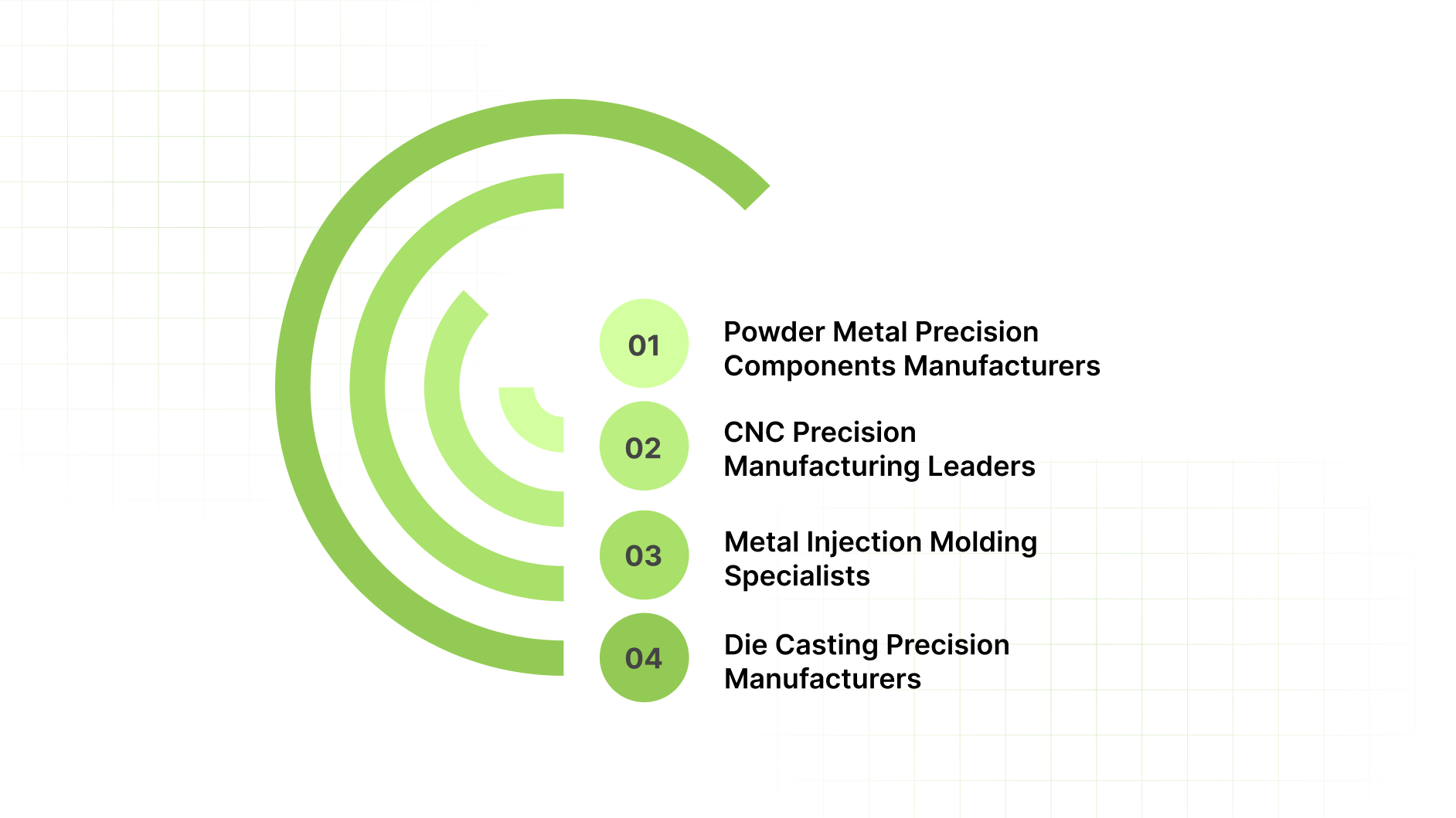
Below are the primary manufacturing archetypes used by precision component manufacturers:
Powder Metal Precision Components Manufacturers
Powder metal manufacturers support programs where repeatability, material yield, and cost stability define long-term outcomes. These suppliers perform best when annual volumes justify tooling investment and consistent mechanical performance matters across production runs.
Here are representative powder metal precision component manufacturers:
Sterling Sintered Technologies: Sterling Sintered Technologies focuses on mid-to-high volume powder metal components, offering net-shape production, in-house tooling, and secondary operations for OEM manufacturing programs.
GKN Powder Metallurgy: GKN Powder Metallurgy operates global production networks that support automotive and industrial platforms, with large-scale capacity and extensive alloy development experience.
Miba Sinter Group: Miba Sinter Group serves demanding automotive and industrial applications, emphasizing sintering control, density consistency, and repeatable output across multiple facilities.
Burgess-Norton: Burgess-Norton supplies powder metal and machined components for industrial and automotive customers, with a strong focus on dimensional repeatability at sustained volumes.
CNC Precision Manufacturing Leaders
CNC-focused manufacturers support rapid iteration and design flexibility during early program phases, pilot builds, and lower annual volumes. These suppliers perform best when geometry changes frequently or when tooling investment must remain minimal.
Here are representative CNC precision manufacturing companies:
Protolabs: Protolabs supports prototyping and short-run production with automated quoting, fast lead times, and limited setup requirements for development teams.
Xometry: Xometry operates a distributed manufacturing network, providing access to varied CNC capabilities while trading direct process control for sourcing breadth.
Fictiv: Fictiv focuses on managed CNC production for product development teams, emphasizing design feedback and supplier coordination during early lifecycle stages.
Metal Injection Molding Specialists
Metal injection molding suppliers support very small, complex components where internal features drive part value. These programs often involve higher tooling costs and longer qualification timelines.
Here are representative metal injection molding companies:
ARC Group Worldwide: ARC Group supports complex MIM components across aerospace, medical, and industrial markets, with emphasis on tooling and sintering control.
Parmatech: Parmatech specializes in precision MIM components for regulated industries, offering deep experience with stainless steel alloys and dimensional control.
Indo-MIM: Indo-MIM operates global facilities supporting high-volume MIM production, with broad material offerings suited for mature programs.
Die Casting Precision Manufacturers
Die casting manufacturers focus on aluminum and zinc components where surface finish consistency and high throughput matter most. These suppliers perform well in non-ferrous applications with stable geometries.
Here are representative die casting precision manufacturers:
Dynacast: Dynacast supports high-volume zinc and aluminum components, serving automotive and electronics markets with consistent cosmetic and dimensional results.
Pace Industries: Pace Industries provides large-scale die casting capacity across North America, supporting complex aluminum programs with integrated secondary operations.
Among these archetypes, powder metal manufacturing stands out when repeatability, material control, and unit cost stability matter across long production runs.
Why Sterling Sintered Technologies Fits High-Volume OEM Programs
Sterling Sintered Technologies supports OEM programs where precision must remain stable as volumes rise and cost pressure tightens over long production lifecycles. The company operates squarely in the space between small job shops and global automotive megasuppliers, focusing on controlled scale, material discipline, and predictable output.
Here are the core capabilities and operating boundaries that define Sterling Sintered Technologies:
In-House Tooling and Manufacturing Control: All compacting dies and punches are designed and built internally, maintaining control over geometry, tolerance behavior, and tooling life throughout long-running programs.
Press Capacity and Compaction Control: Production centers around presses up to 110 tons, with multi-level compacting capability supporting complex geometries, controlled density distribution, and consistent dimensional results across extended runs.
Secondary Operations and Supply Simplification: Capabilities include sizing, coining, heat treatment, CNC machining, surface finishing, impregnation, and sub-assembly, reducing supplier handoffs and production risk.
Material Families Supported: Manufacturing programs focus exclusively on iron, bronze, stainless steel in the 300 and 400 series, and brass, ensuring process depth and repeatability within these proven powder metal systems.
Volume Sweet Spot: Sterling Sintered Technologies is best suited for programs ranging from approximately 500 parts per year to 500,000 parts per week, where tooling investment and process control deliver measurable cost stability.
Quality Systems and Process Control: ISO 9001:2015 registration supports disciplined process control, SPC monitoring, documented validation, and lot traceability that sustain dimensional stability after production ramps.
Part Size Discipline: Components over 500 grams usually fall outside the core production focus, enabling tighter control over press behavior, sintering consistency, and dimensional repeatability for small-to-medium precision parts.
Manufacturability Consultation: Once part designs are finalized, engineering teams support PM-specific refinements that reduce secondary steps, stabilize tolerances, and lower total cost per part without altering functional intent.
This operating model positions Sterling Sintered Technologies as a practical manufacturing partner for OEMs that require repeatable precision, defined scale boundaries, and disciplined material control across sustained production programs.
Conclusion
Selecting a precision manufacturing partner requires more than tolerance charts or early production results, because long-term outcomes depend on repeatability, material control, and supply reliability at sustained volumes. OEM teams reduce risk when supplier selection reflects cost behavior, capacity stability, and quality discipline across the full production lifecycle.
If your programs require high-precision powder metal components with predictable performance at scale, Sterling Sintered Technologies offers manufacturing depth built for long-running OEM production.
Contact us today to discuss volume requirements, geometry considerations, and material needs before committing to production tooling.
FAQs
When should OEMs involve a powder metal manufacturer in the product lifecycle?
OEMs benefit from early supplier engagement once target volumes, load conditions, and tolerance ranges become clear, even if detailed drawings are still under development. Early discussion helps avoid geometry decisions that later require costly redesigns or secondary machining.
How do powder metal components perform under fatigue and wear compared to machined parts?
Performance depends on alloy selection, density targets, and post-sinter operations rather than the forming method alone. Properly specified powder metal parts can meet demanding fatigue, wear, and load requirements across long production runs.
What program risks increase when switching suppliers after production launch?
Late supplier changes often introduce tooling requalification, dimensional variation, and extended downtime during validation. These transitions frequently cost more than expected due to rework, missed deliveries, and internal resource diversion.
How should OEMs think about design tolerances for powder metal parts?
Tolerances should reflect functional requirements rather than default machined standards. Clear communication around critical features allows suppliers to focus control where performance matters, while avoiding unnecessary cost drivers.
What signals indicate a powder metal supplier may struggle at scale?
Warning signs include limited press size ranges, outsourced tooling, inconsistent material sourcing, and unclear capacity planning. These issues often appear only after volume increases, making early evaluation essential.