In advanced manufacturing, not all parts are created equal, and powder metal parts are a clear example of how innovation can redefine industry standards. These components are quietly powering billions of products across the globe, bridging the gap between precision engineering and scalable production.
Analysts project the global powder metallurgy market to grow from roughly USD 3.34 billion in 2025 to over USD 8.15 billion by 2033, driven by increasing demand for high-performance, cost-effective parts across multiple industries.
Whether fabricating components for the automotive sector, industrial machinery, or consumer electronics, powder metallurgy delivers repeatable accuracy with significantly reduced material waste.
This combination excites manufacturers focused on quality and efficiency. With the ability to support high-volume production while optimizing material properties, powder metal parts are more than just functional pieces; they’re strategic assets in the race toward smarter, leaner manufacturing.
Key Highlights
Powder metal parts deliver high precision, tight tolerances, and complex geometries that are difficult or costly to achieve through machining.
Powder metallurgy ensures exceptional material efficiency, using up to 97% of raw material with minimal scrap, ideal for sustainable, cost-driven manufacturing.
Engineered performance properties, like controlled porosity, self-lubrication, and wear resistance, make PM parts suitable for demanding applications.
Widely used across automotive, industrial machinery, appliances, aerospace, and medical devices, powder metal parts combine scalability with consistent performance.
Sterling Sintered Technologies enhances PM capabilities with in-house tooling, high-volume precision manufacturing, and comprehensive secondary operations.
What Are Powder Metal Parts?
Powder metal parts are engineered components produced through powder metallurgy, a manufacturing process that transforms fine metal powders into strong, precise, and repeatable parts. Instead of cutting material away (as in traditional machining), powder metallurgy builds parts from the ground up, resulting in minimal waste and excellent material utilization.
Why powder metal parts stand out?
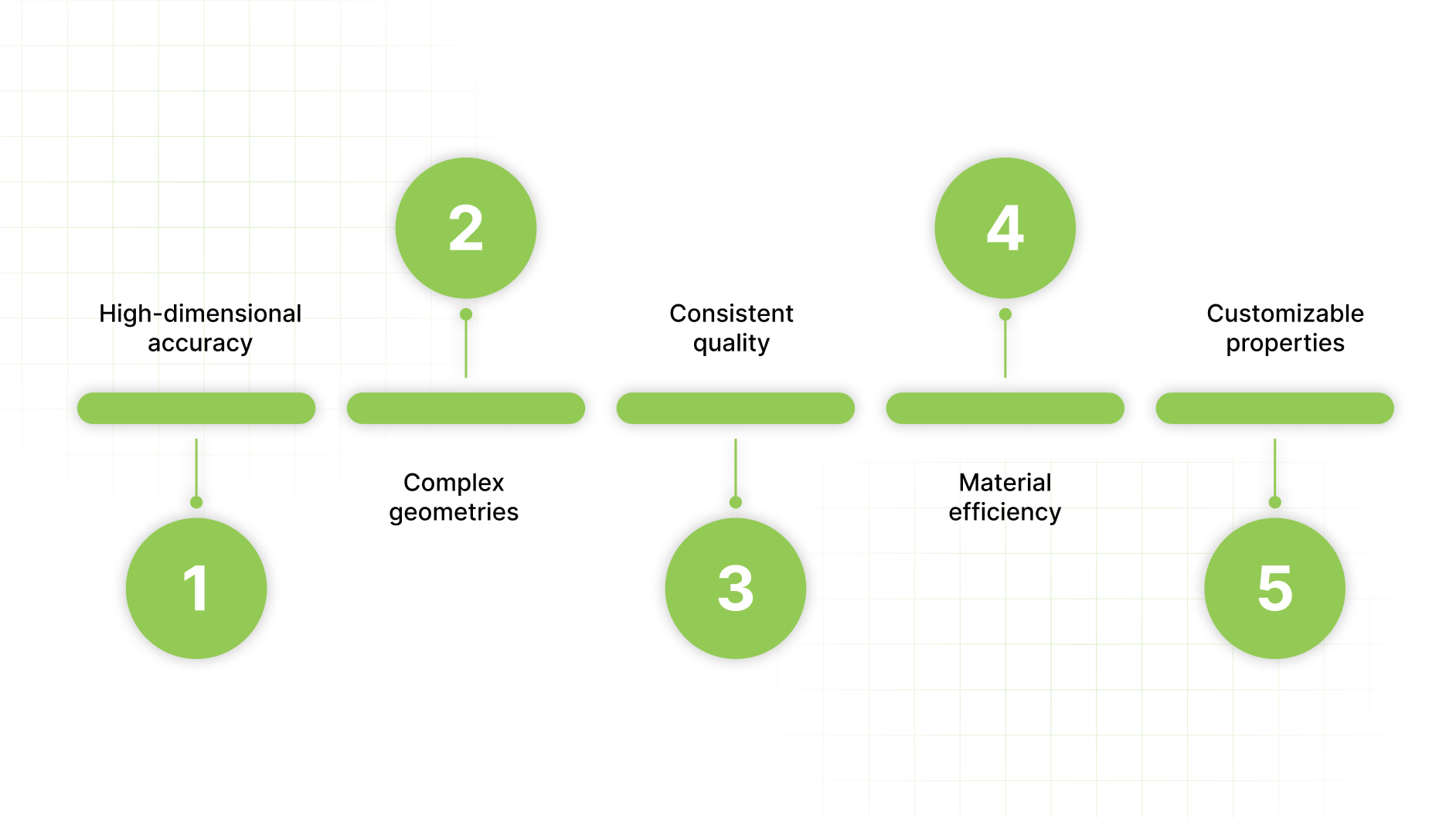
Powder metal parts stand out because they combine precise engineering, material efficiency, and cost-effective mass production for high-performance applications.
High-dimensional accuracy and tight tolerances
Complex geometries that are difficult or costly to machine
Consistent quality across high-volume production runs
Material efficiency, with significantly less scrap than machining
Customizable properties, including porosity for self-lubrication or weight reduction
Because of these advantages, powder metal parts are widely used in automotive systems, industrial equipment, power tools, appliances, and emerging electric vehicle applications, where performance, reliability, and cost control are equally critical.
How Powder Metal Parts Are Manufactured
The powder metallurgy process blends material science, controlled processing, and precision tooling to produce high-quality components with excellent repeatability, especially at high volumes. Each stage of manufacturing plays a critical role in determining the final part’s strength, accuracy, and performance.
1. Metal Powder Production
The process begins with the creation of metal powders using methods such as atomization, reduction, or electrolysis. These techniques produce powders with controlled particle size, shape, and chemical composition. Precise powder characteristics are essential, as they directly influence flowability, compressibility, and final mechanical properties.
2. Compaction in Precision Dies
The prepared powder blend is fed into a hardened steel die and compacted under high pressure. This forms a “green part” that closely matches the final component’s geometry. Precision dies allow manufacturers to achieve tight tolerances and complex shapes while minimizing the need for additional machining.
3. Sintering for Strength and Density
After compaction, green parts are sintered in a temperature-controlled furnace, typically under a protective atmosphere. During sintering, metal particles bond at the atomic level, significantly increasing strength and density without fully melting the material. This step transforms the compacted powder into a solid, functional component.
4. Secondary Operations
Depending on application requirements, powder metal parts may undergo additional finishing processes, including:
Sizing or coining to improve dimensional accuracy
Heat treatment to enhance strength, hardness, or wear resistance
Impregnation with oils or resins to improve lubrication and sealing
Machining or surface finishing for critical features or aesthetics
Together, these steps enable powder metallurgy to deliver consistent, cost-effective, and high-performance parts that meet demanding industrial specifications, making it a preferred solution for large-scale manufacturing.
5 Key Benefits of Powder Metal Parts

Powder metallurgy delivers a unique combination of manufacturing efficiency, precision, and performance, making it a preferred solution for high-volume and high-performance applications across multiple industries.
1. Cost Efficiency
Powder metallurgy significantly lowers total production costs, particularly in large-scale manufacturing.
Near-net-shape production minimizes or eliminates machining.
Reduced labor and processing time per part.
Lower scrap rates compared to subtractive methods.
Economical for long production runs once tooling is amortized.
2. Design Flexibility
The process enables engineers to design parts based on function rather than machining limitations.
Complex geometries and intricate features formed directly in the die
Internal shapes and multi-level features are achievable without assembly
Reduced part count by combining multiple functions into one component
Greater freedom to optimize designs for performance and cost
3. Material Utilization
Powder metallurgy is one of the most material-efficient manufacturing methods available.
Material utilization rates of up to 97%
Minimal waste compared to machining from solid stock
Unused powder can often be recycled back into production
Supports sustainability and cost-reduction initiatives
4. Consistent Quality
Highly controlled processes ensure repeatable results across large production volumes.
Uniform density and mechanical properties from part to part
Tight dimensional tolerances are maintained over long runs
Reduced variation compared to multi-step machining processes
Ideal for industries requiring reliability and repeatability
5. Enhanced Performance Properties
Powder metallurgy allows material properties to be engineered for specific applications.
Controlled porosity enables self-lubrication and noise reduction
Improved wear resistance and surface durability
Alloy customization to meet strength, hardness, or thermal needs
Performance tuning without adding secondary assembly steps
Together, these benefits make powder metal parts a strategic manufacturing advantage, delivering reliable performance, scalable production, and long-term cost efficiency without compromising quality.
Common Applications of Powder Metal Parts
Powder metal components are widely used in industries that require precision manufacturing, consistent quality, and cost-effective high-volume production. Their flexibility in material selection and design makes them suitable for both structural and functional applications.
1. Automotive Industry
The automotive industry relies heavily on powder metallurgy to meet demanding performance and production requirements.
Powder metal parts are used throughout vehicles to deliver durability, accuracy, and large-scale repeatability.
Gears, sprockets, and timing components for engines and transmissions
Bearings and bushings with self-lubricating properties
Structural and functional parts in drivetrains and steering systems
Components designed for noise reduction, wear resistance, and long service life
2. Industrial Machinery
Industrial machinery operates in high-load, high-wear environments where reliability is critical.
Powder metal parts provide the strength and wear resistance needed for continuous operation.
Cams, rollers, and followers are subjected to repeated motion
Structural supports and load-bearing components
Wear-resistant parts used in material handling and processing equipment
Components designed for consistent performance under stress
3. Consumer Appliances
Appliances demand compact, efficient, and durable components that operate quietly over long periods.
Powder metallurgy enables reliable mass production of these essential parts.
Motor components for washing machines, refrigerators, and HVAC systems
Compressor and pump parts requiring dimensional stability
Mechanical assemblies designed for low maintenance and long service life
Cost-efficient components supporting high-volume appliance manufacturing
4. Aerospace and Defense
Aerospace and defense applications require strict quality control and material consistency.
Powder metal parts are used where precision and repeatability are more critical than extreme structural loading.
Secondary structural components and brackets
Mechanical subassemblies with controlled material properties.
Components requiring tight tolerances and weight optimization.
Parts are produced under rigorous quality and traceability standards
5. Medical and Electrical Components
Medical and electrical industries demand precision, reliability, and repeatable material behavior.
Powder metallurgy supports these needs through controlled manufacturing processes.
Small, high-precision components for medical devices and instruments
Electrical contacts, connectors, and sensor components
Parts requiring consistent density and dimensional accuracy
Components manufactured to meet regulatory and performance standards
These applications highlight the versatility of powder metal parts and explain why powder metallurgy continues to expand across industries focused on performance, scalability, and manufacturing efficiency.
Powder Metal Parts vs. Traditional Machining
Choosing between powder metal parts and traditional machining depends on production volume, part complexity, and performance requirements. While both methods have their place in manufacturing, powder metallurgy often delivers clear advantages when scalability and efficiency are priorities.
Decision Factor | Powder Metal Parts | Traditional Machining |
|---|---|---|
Ideal Production Volume | Optimized for medium-to-high volumes (thousands to millions of parts) where tooling cost is amortized. | Best for low volumes, prototypes, or custom one-off parts. |
Cost Structure | Higher upfront tooling cost but significantly lower per-part cost at scale. | Low initial setup cost but higher cost per part due to labor and machine time. |
Material Utilization & Waste | Uses up to 97% of raw material, producing minimal scrap and supporting sustainability goals. | Subtractive process generates substantial scrap, increasing material and disposal costs. |
Design & Geometry Freedom | Enables complex shapes, internal features, and near-net geometries without extra machining. | Limited by tool access, cutter paths, and fixturing constraints |
Dimensional Consistency | Excellent repeatability with tight tolerances across long production runs. | Tolerances can vary across batches and machines, especially at high volumes. |
Post-Processing Requirements | Minimal secondary operations; sizing or heat treatment only when needed. | Often requires multiple finishing steps (drilling, grinding, polishing) |
Mechanical Properties | Properties can be engineered through alloy selection and porosity control. | Fully dense parts with very high strength and toughness are achievable. |
Weight & Functional Optimization | Controlled porosity allows lighter parts, self-lubrication, and noise reduction. | Weight reduction requires additional design or machining steps. |
Lead Time Efficiency | Faster cycle times once production is established. | Faster turnaround for short runs and design changes. |
Design Change Flexibility | Design changes may require new tooling. | Design changes are easier and faster to implement. |
Best-Fit Applications | Automotive, industrial machinery, appliances, and high-volume precision components. | Prototyping, aerospace critical parts, custom or ultra-high-strength components. |
Design Considerations for Powder Metal Parts
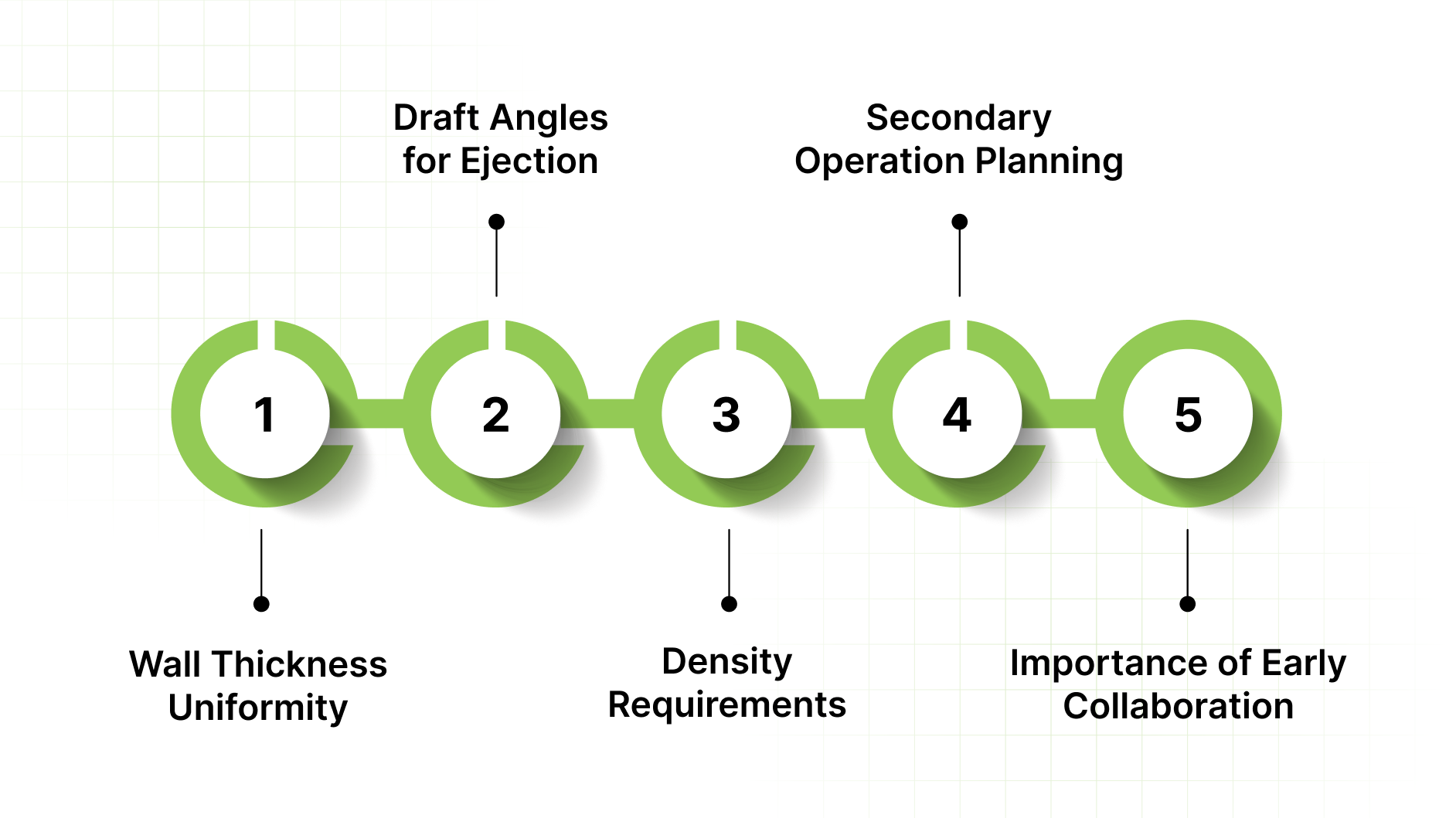
Successful powder metal part design starts with a clear understanding of process-specific capabilities and limitations. Designing with powder metallurgy in mind from the outset helps maximize performance, control costs, and avoid unnecessary secondary operations.
Wall Thickness Uniformity: Consistent wall thickness is critical in powder metallurgy. Uniform sections promote even powder flow and compaction, reducing density variation, distortion, and the risk of cracking during sintering.
Draft Angles for Ejection: Proper draft angles are required to eject compacted parts cleanly from the die. Incorporating an adequate draft early in the design minimizes tooling wear, prevents part damage, and improves production efficiency.
Density Requirements: Powder metal parts can be engineered with specific density levels depending on performance needs. Designers must balance strength, wear resistance, and porosity, as higher densities typically improve mechanical properties but may increase tooling pressure and cost.
Secondary Operation Planning: Some features or tolerances may require post-sintering operations. Planning for sizing, heat treatment, machining, or impregnation during the design phase ensures feasibility, avoids costly redesigns, and shortens time to production.
Importance of Early Collaboration: Early collaboration with powder metallurgy and tooling experts is essential. Working closely with manufacturing specialists helps optimize geometry, material selection, and process flow, resulting in better-performing parts, lower production costs, and faster time to market.
When to Choose Powder Metal Parts
Powder metal parts are the optimal choice when a project demands manufacturing efficiency, design precision, and long-term cost savings. They deliver the greatest value when the application is aligned with the core strengths of powder metallurgy.
High-volume production programs where repeatability and low per-part cost are critical.
Components with complex geometries, internal features, or near-net shapes that would be costly to machine.
Applications requiring tight tolerances and consistent dimensional control across large production runs.
Designs aimed at reducing secondary machining, assembly steps, or overall part count.
Cost-driven projects focused on minimizing material waste and maximizing material utilization.
Parts that benefit from engineered material properties such as controlled porosity, wear resistance, or self-lubrication.
Long-term programs with stable designs where tooling investment delivers a strong return over time.
When these conditions are present, powder metallurgy provides a strategic manufacturing advantage, balancing performance, scalability, and cost efficiency while maintaining reliable, repeatable quality.
How Sterling Sintered Technologies Supports the Powder Metal Industry
Sterling Sintered Technologies is a well-established powder metallurgy manufacturer with deep technical expertise in sintered metal components. Its capabilities reflect how powder metallurgy delivers precision, consistency, and cost efficiency across demanding manufacturing environments.
Capability Category | What They Offer | Value / Benefit |
|---|---|---|
Part Size Range | Miniature to 500 g parts | Supports both small precision pieces and larger components. |
Materials (Ferrous) | Iron & steel alloys, copper-infiltrated & soft magnetic steels | Versatile metal choices for strength, magnetic, or conductive needs. |
Materials (Stainless) | 300 & 400 series stainless powder | Corrosion-resistant parts for demanding applications. |
Materials (Non-Ferrous) | Brass, bronze, nickel silver, heavy hybrids | Broad material range for varied mechanical/functional needs. |
Production Quantity | Small prototype lots to high-volume runs | Flexible output from testing to mass production. |
Secondary Services | Heat treat, oxidation, infiltration, machining, finishing, assembly | One-stop shop that enhances part performance & function. |
Tolerances & Complexity | Net/near-net shapes, statistical process controls | Tight tolerances, reduced machining, consistent quality. |
Manufacturing Systems | 24+ compaction presses (4 – 110 tons) | Handles complex shapes and high compaction pressure requirements. |
Production Scale | From 500 parts/year to hundreds of thousands/week | Capable of scaling with customer demand. |
In-House Tooling and Precision Manufacturing: All tooling is designed and built internally by experienced toolmakers, allowing tight control over tolerances and geometry. This capability supports complex part designs, high compaction pressures, and consistent quality across large production runs.
Comprehensive Secondary Operations: To meet specific performance and dimensional requirements, Sterling Sintered offers secondary services such as sizing, coining, heat treatment, CNC machining, surface finishing, and impregnation. These processes enhance strength, accuracy, and functional performance.
Broad Industry Support: The company serves industries including medical devices, plumbing, lock hardware, power tools, firearms, appliances, and lawn & garden equipment, highlighting the versatility of powder metal components across varied applications.
Quality-Driven Manufacturing: As an ISO 9001:2015–registered manufacturer, Sterling Sintered prioritizes quality control, delivery reliability, and customer collaboration. Early engineering involvement helps reduce redesigns, improve manufacturability, and ensure consistent production outcomes.
This combination of experience, technical capability, and quality focus demonstrates how powder metallurgy, when executed by an experienced manufacturer, supports efficient, reliable, and scalable component production.
Conclusion
Powder metal parts combine efficiency, precision, and scalability, making them a smart choice for modern manufacturing. When designed correctly, powder metallurgy delivers consistent quality, optimized material use, and long-term performance across automotive, industrial, and consumer applications.
If you’re considering powder metal components, Sterling Sintered Technologies offers the expertise and in-house capabilities to support your project from design to production. Partner with Sterling Sintered Technologies to achieve reliable, cost-effective, and high-quality powder metal solutions.
FAQs
1. What industries commonly use powder metal parts?
Powder metal parts are widely used in automotive, industrial machinery, consumer appliances, aerospace, medical, and electrical applications due to their consistency and scalability.
2. Are powder metal parts strong enough for demanding applications?
Yes, for many applications. While some powder metal parts may have lower tensile strength than forged parts, strength can be optimized through density control, alloy selection, and secondary processing.
3. What are the main advantages of powder metallurgy?
Key advantages include cost efficiency at scale, design flexibility, high material utilization, consistent quality, and the ability to tailor material properties for specific performance needs.
4. What are the limitations of powder metal parts?
Limitations include higher tooling costs for low-volume production, size constraints based on press capacity, and reduced suitability for extreme load or impact applications without secondary densification.
5. Is powder metallurgy suitable for low-volume production?
Generally, no. Powder metallurgy is most cost-effective for medium-to-high volume production, while machining or additive manufacturing is better suited for prototypes or short runs.