Manufacturers today are under pressure to deliver greater precision, lower waste, and consistent quality, all at scale. Powder metallurgy meets that challenge head-on, emerging as a high-efficiency manufacturing process for producing complex metal components with exceptional accuracy. The global powder metallurgy market is already valued in the billions of dollars. It is projected to surpass USD 7.9 billion by 2030, driven by strong demand from automotive, aerospace, and industrial sectors.
One of its biggest advantages lies in material efficiency. Powder metallurgy can convert up to 95–97 % of raw material into finished parts, significantly reducing scrap compared to conventional machining methods. This combination of precision, repeatability, and sustainability has made powder metallurgy a preferred choice for industries where performance and cost control are critical.
Key Highlights
Powder metallurgy converts 95–97% of raw material into finished parts, reducing scrap and boosting sustainability.
Enables near-net-shape production, minimizing machining and improving dimensional accuracy.
Supports complex geometries and tight tolerances, ideal for high-volume, precision-driven manufacturing.
Widely used across automotive, aerospace, industrial, medical, and electrical applications.
Sterling Sintered Technologies offers end-to-end PM solutions, including design support, sintering, and secondary operations.
What Is Powder Metallurgy?
Powder metallurgy is a metal-forming process in which fine metal powders are compacted into precise shapes and then bonded using controlled heat and pressure. Unlike traditional casting or machining, this method produces near-net-shape components, meaning parts require little to no additional finishing. The result is optimized material usage, tight dimensional control, and consistent quality, making powder metallurgy ideal for complex geometries and high-volume production.
Why Powder Metallurgy Is Used in Modern Manufacturing
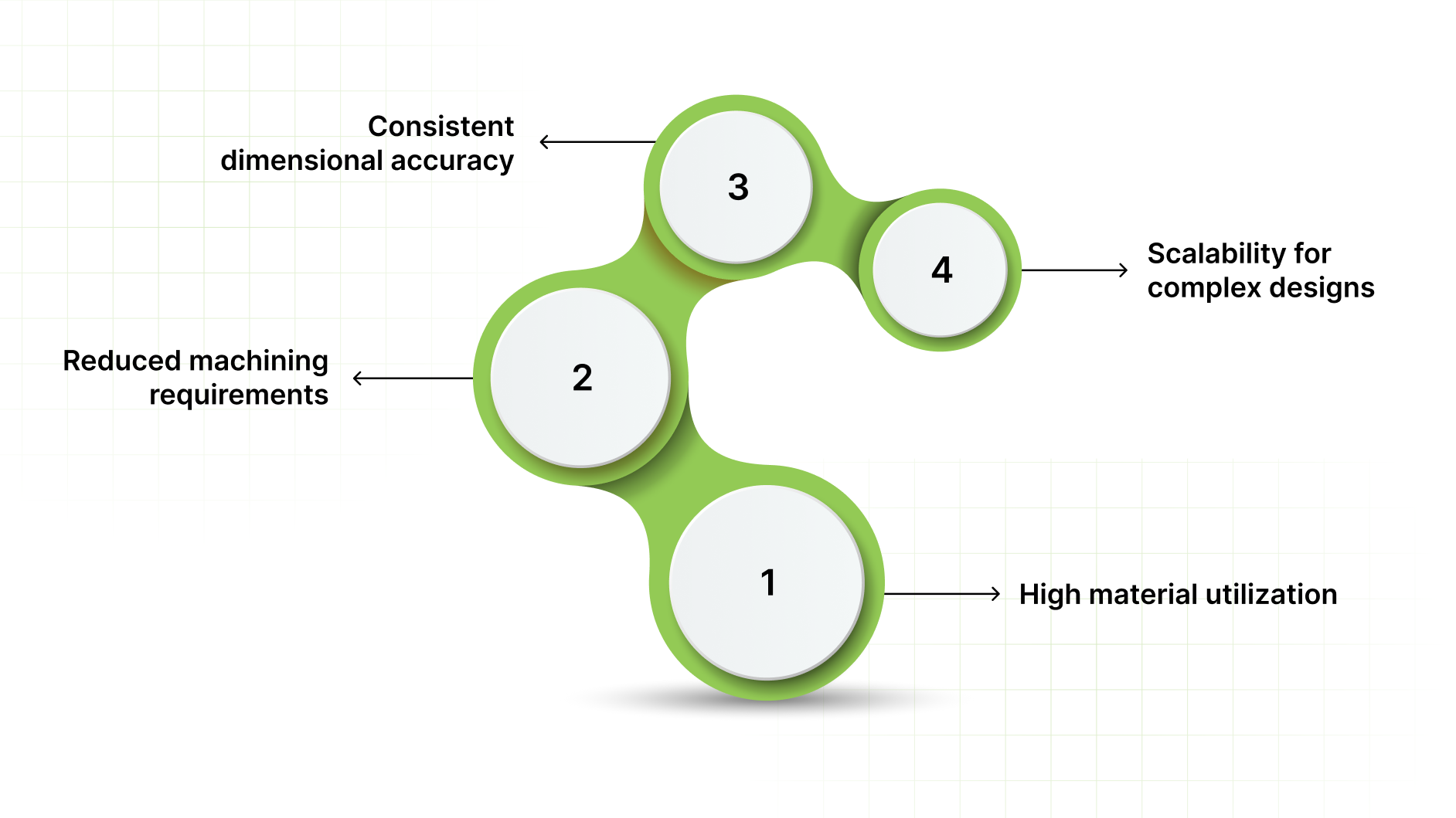
Powder metallurgy has become a preferred manufacturing method because it delivers an effective balance of performance, cost efficiency, and scalability. Forming components close to their final shape, it enables manufacturers to meet tight tolerances while keeping production costs under control.
Key advantages include:
High material utilization – most of the raw metal is converted into usable parts, minimizing scrap
Reduced machining requirements – near-net-shape production limits secondary operations
Consistent dimensional accuracy – repeatable processes ensure uniform part quality
Scalability for complex designs – intricate geometries can be produced efficiently in high volumes
These benefits make powder metallurgy especially valuable in industries where precision, reliability, and high-volume production are critical.
The Powder Metallurgy Process: Step-by-Step
The powder metallurgy process is engineered to deliver precision, repeatability, and production efficiency. Each stage is carefully controlled to ensure the final component meets specific mechanical, dimensional, and functional requirements, making the process ideal for high-volume and high-precision manufacturing.
1. Metal Powder Production
The process begins with the creation of metal powders using methods such as atomization, chemical reduction, or electrolysis. The selected method depends on the required material properties and end-use application.
Key considerations at this stage include:
Particle size and size distribution
Particle shape and surface characteristics
Chemical composition and purity
These factors directly influence flowability, compressibility, density, surface finish, and final part strength.
2. Powder Blending and Mixing
Metal powders are blended with alloying elements, lubricants, or other additives to achieve desired mechanical and physical properties.
This step ensures:
Uniform material composition throughout the part
Consistent mechanical properties such as strength and hardness
Improved wear resistance and controlled friction characteristics
Repeatable performance across large production batches
Proper blending is critical for maintaining quality and minimizing variability in finished components.
3. Compaction
The blended powder is pressed into a precision die under high pressure to form a “green part.” While the green part has limited strength, it closely resembles the final component in shape and size.
Compaction influences:
Final part geometry and dimensional accuracy
Green density and uniformity
Mechanical strength after sintering
Tooling life and production consistency
Accurate compaction is essential for achieving tight tolerances and uniform density.
4. Sintering
Green parts are heated in a controlled-atmosphere furnace at temperatures below the metal’s melting point. During sintering, metal particles bond at the molecular level without losing shape.
Sintering results in:
Significant increases in strength and density
Improved structural integrity and durability
Stable dimensional control
Enhanced material properties tailored to application needs
This step transforms fragile green parts into fully functional metal components.
5. Secondary Operations
Depending on design and performance requirements, additional processes may be applied to enhance part functionality further.
Common secondary operations include:
Sizing or coining for tighter tolerances
Machining for critical features
Heat treatment to improve strength or hardness
Surface coatings for corrosion or wear resistance
Impregnation for improved lubrication or sealing
These operations allow powder metallurgy components to meet demanding performance, surface, and dimensional specifications.
Materials Commonly Used in Powder Metallurgy
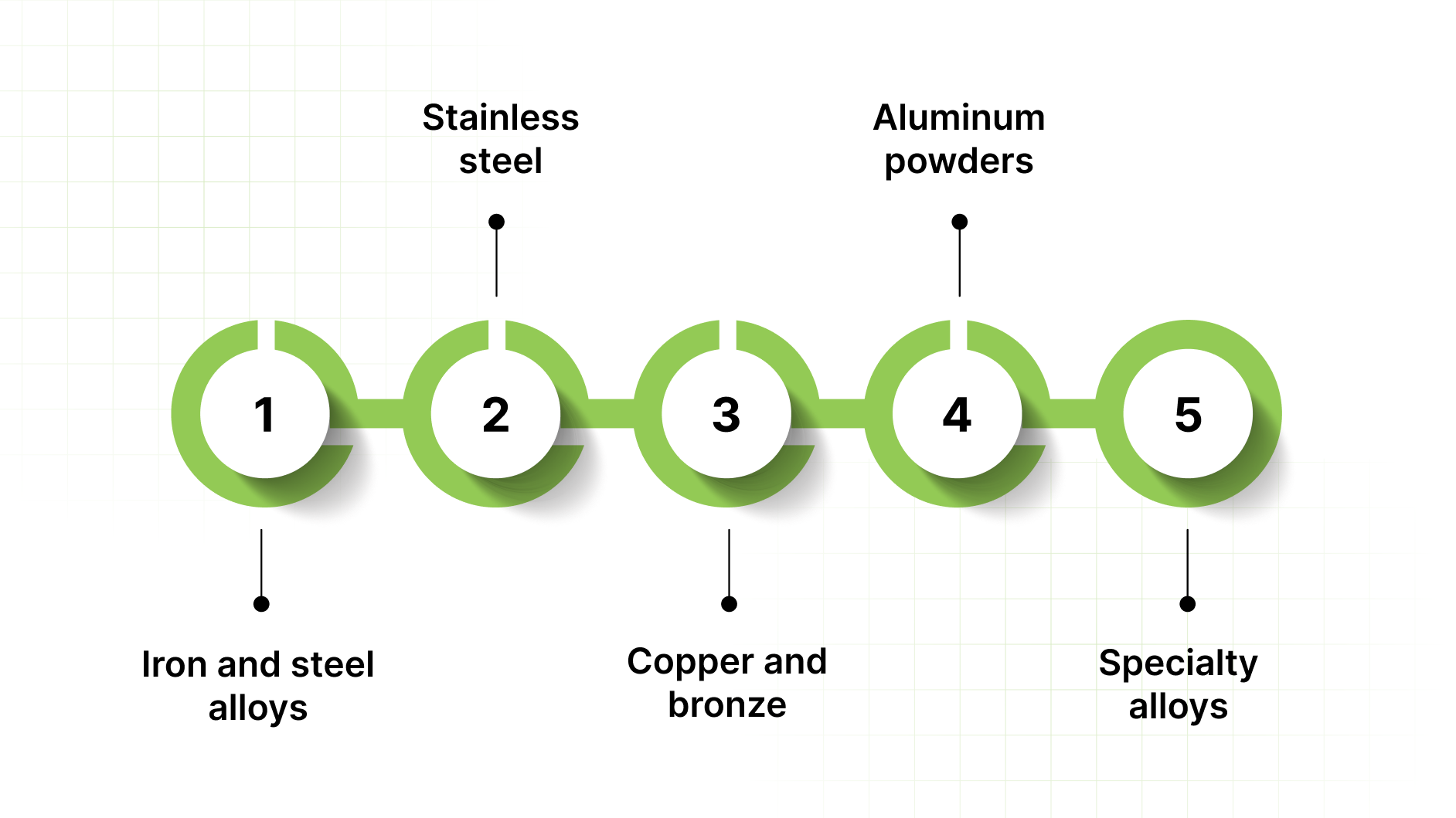
Powder metallurgy supports a broad range of materials, allowing manufacturers to tailor components to specific mechanical, thermal, and chemical performance requirements. Material selection depends on factors such as strength, wear resistance, corrosion resistance, and operating environment.
Commonly used materials include:
Iron and steel alloys – Widely used for structural and automotive parts due to their strength, durability, and cost-effectiveness
Stainless steel – Offers excellent corrosion resistance and is ideal for medical, food-processing, and chemical applications.
Copper and bronze – Valued for their high thermal and electrical conductivity, often used in bearings and electrical components.
Aluminum powders – Lightweight with good strength-to-weight ratio, suitable for aerospace and automotive applications
Specialty alloys (nickel-, cobalt-, and titanium-based) – Designed for high-temperature, high-stress, or corrosive environments, commonly used in aerospace, energy, and advanced industrial applications
This material versatility enables powder metallurgy to meet the demands of both high-volume production and specialized, performance-critical components.
Key Advantages of Powder Metallurgy
Powder metallurgy is more than a cost-saving manufacturing method; it is a performance-driven, precision-focused process that enables manufacturers to meet demanding design, quality, and production goals. When leveraged correctly, it delivers advantages that extend across the entire product lifecycle.
Efficient Material Use: Powder metallurgy is highly material-efficient, with up to 97% of raw material converted into finished parts. This dramatically reduces scrap, lowers material costs, and supports more sustainable manufacturing practices.
Design and Engineering Flexibility: The process enables the production of complex geometries, internal features, and controlled porosity that are difficult or costly to achieve with traditional methods. Many components can be produced to near-net shape, minimizing the need for secondary machining.
Cost-Effective at Scale: Powder metallurgy is particularly economical for high-volume production. Once tooling is in place, parts can be produced rapidly with minimal waste and consistent cycle times, driving down per-unit costs.
Consistent Quality and Performance: Tightly controlled processing parameters ensure excellent repeatability and uniform material properties. This consistency allows manufacturers to produce thousands, or even millions, of identical components with reliable performance.
Together, these advantages make powder metallurgy a strategic manufacturing choice for companies seeking precision, scalability, sustainability, and long-term cost control across demanding industrial applications.
Applications of Powder Metallurgy Across Industries
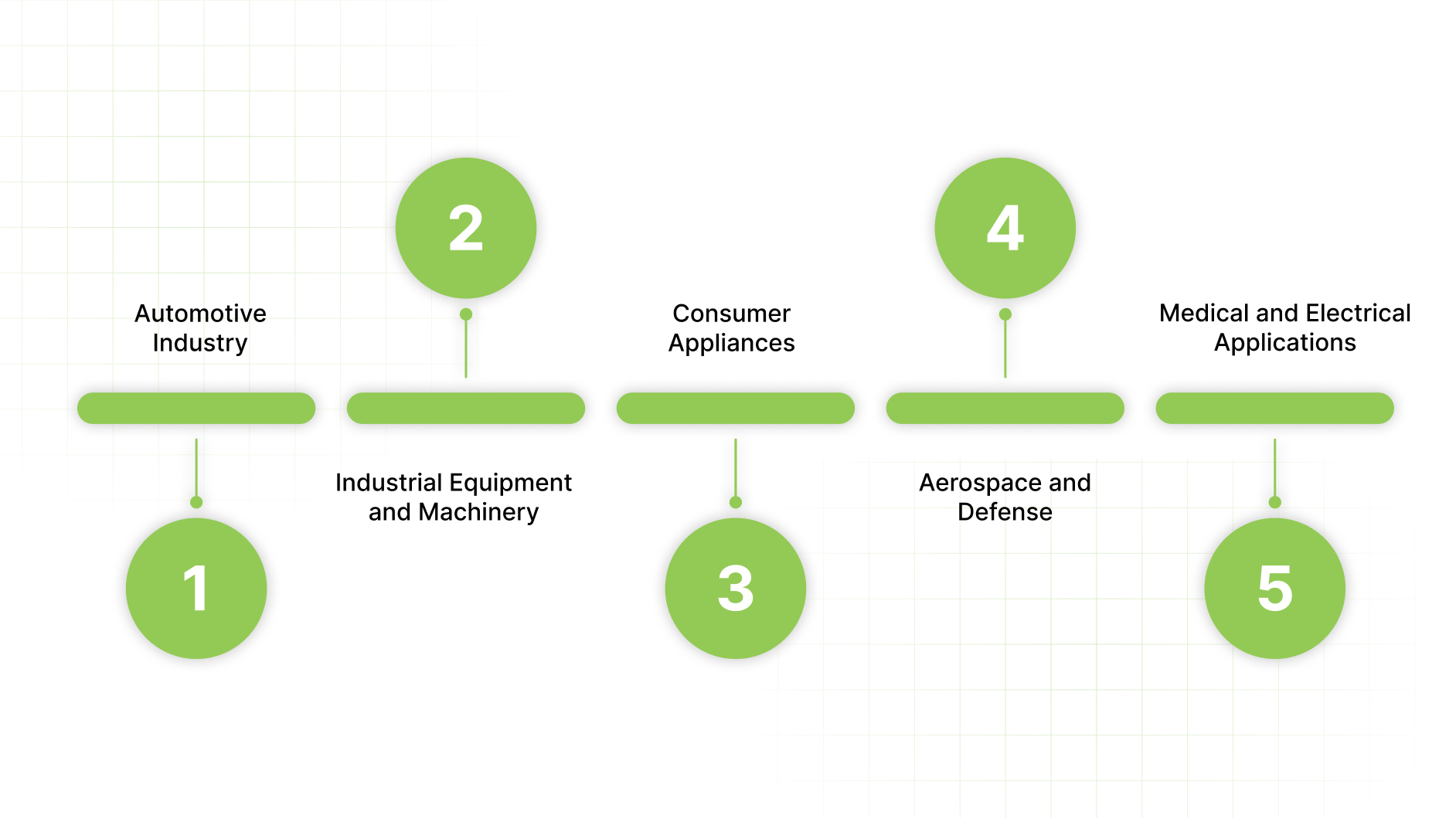
Powder metallurgy is widely adopted across industries that demand precision, durability, and cost-efficient mass production. Its ability to produce complex, repeatable components makes it suitable for both high-volume and performance-critical applications.
1. Automotive Industry
Powder metallurgy is extensively used in automotive manufacturing due to its efficiency and consistency.
Gears, sprockets, and transmission components
Bearings and bushings for reduced friction and wear
Structural parts and brackets
Engine components such as valve guides and timing parts
2. Industrial Equipment and Machinery
The process is ideal for components exposed to high loads, friction, and continuous operation.
Wear-resistant cams and rollers
Mechanical supports and housings
Bushings and sliding components
Parts requiring controlled porosity for lubrication
3. Consumer Appliances
Powder metallurgy supports reliable, high-volume production for everyday appliances.
Electric motor components
Compressor parts
Gears and mechanical assemblies
Noise- and vibration-reducing components
4. Aerospace and Defense
In aerospace and defense, powder metallurgy is used where material efficiency, weight control, and precision are critical.
Secondary structural components
Lightweight mechanical parts
Specialized alloy components for demanding environments
5. Medical and Electrical Applications
Powder metallurgy enables tight control over material properties for precision-driven sectors.
Medical device components with consistent tolerances
Electrical contacts and connectors
Magnetic components and sensor parts
Precision components requiring repeatability and reliability.
Powder Metallurgy vs Traditional Manufacturing Methods
When selecting a manufacturing process, it’s important to compare performance, cost, and production efficiency. Powder metallurgy differs significantly from traditional methods like casting and machining, particularly in high-volume and precision-driven applications.
Factor | Powder Metallurgy | Traditional Casting & Machining |
|---|---|---|
Material Utilization | Very high; low scrap rates due to near-net-shape production | Lower; excess material is often removed during machining |
Post-Processing | Minimal secondary operations required | Extensive machining and finishing are often needed |
Dimensional Control | Excellent consistency and tight tolerances | Tolerances depend heavily on machining operations |
Complex Geometries | Easily produces complex shapes and internal features | Complex designs increase cost and processing time |
Cost Efficiency | Highly cost-effective for high-volume production | More economical for low-volume or custom parts |
Production Scalability | Ideal for large-scale, repeatable manufacturing | Scaling up increases time and cost significantly |
High-Load Applications | Suitable for many applications, but with limitations | Better suited for extremely high-load or critical structural parts |
Overall, powder metallurgy provides lower scrap rates, reduced post-processing, superior dimensional consistency, and strong cost advantages at scale. However, traditional manufacturing methods may still be preferable for low-volume production or components subjected to extreme mechanical loads.
Design Considerations for Powder Metallurgy
Designing components for powder metallurgy requires a clear understanding of the process capabilities and limitations. When parts are designed correctly from the outset, manufacturers can achieve optimal performance, dimensional accuracy, and cost efficiency.
Key design considerations include:
Uniform wall thickness: Maintaining consistent wall thickness helps ensure even powder flow, uniform compaction, and consistent density throughout the part, reducing the risk of defects.
Proper draft angles: Incorporating suitable draft angles allows parts to be ejected smoothly from the die, minimizing tool wear and preventing part damage during compaction.
Density and strength requirements: Designers must account for required density levels, as density directly affects mechanical strength, fatigue resistance, and overall performance of the final component.
Planning for secondary operations: If tighter tolerances, surface finishes, or enhanced properties are needed, secondary operations such as sizing, machining, or heat treatment should be considered early in the design phase.
By aligning design intent with process capabilities, powder metallurgy enables reliable production, reduced rework, and long-term cost savings.
Limitations of Powder Metallurgy
While powder metallurgy offers many advantages, it is not suitable for every application. Understanding its limitations helps manufacturers choose the right process and avoid design or cost challenges.
Limitation | Description | Impact on Application |
|---|---|---|
Initial tooling investment | Precision dies and tooling require higher upfront costs. | Less economical for low-volume or prototype production. |
Part size limitations | Component size is constrained by press capacity and tooling. | Large or bulky parts may require alternative manufacturing methods. |
Strength limitations | Density and load-bearing capacity can be lower than those of wrought or forged parts. | Not ideal for extremely high-load or critical structural components. |
Despite these constraints, powder metallurgy remains highly effective when applied to appropriately sized parts, suitable load conditions, and high-volume production runs. Evaluating these factors early ensures the process delivers maximum value.
When to Choose Powder Metallurgy
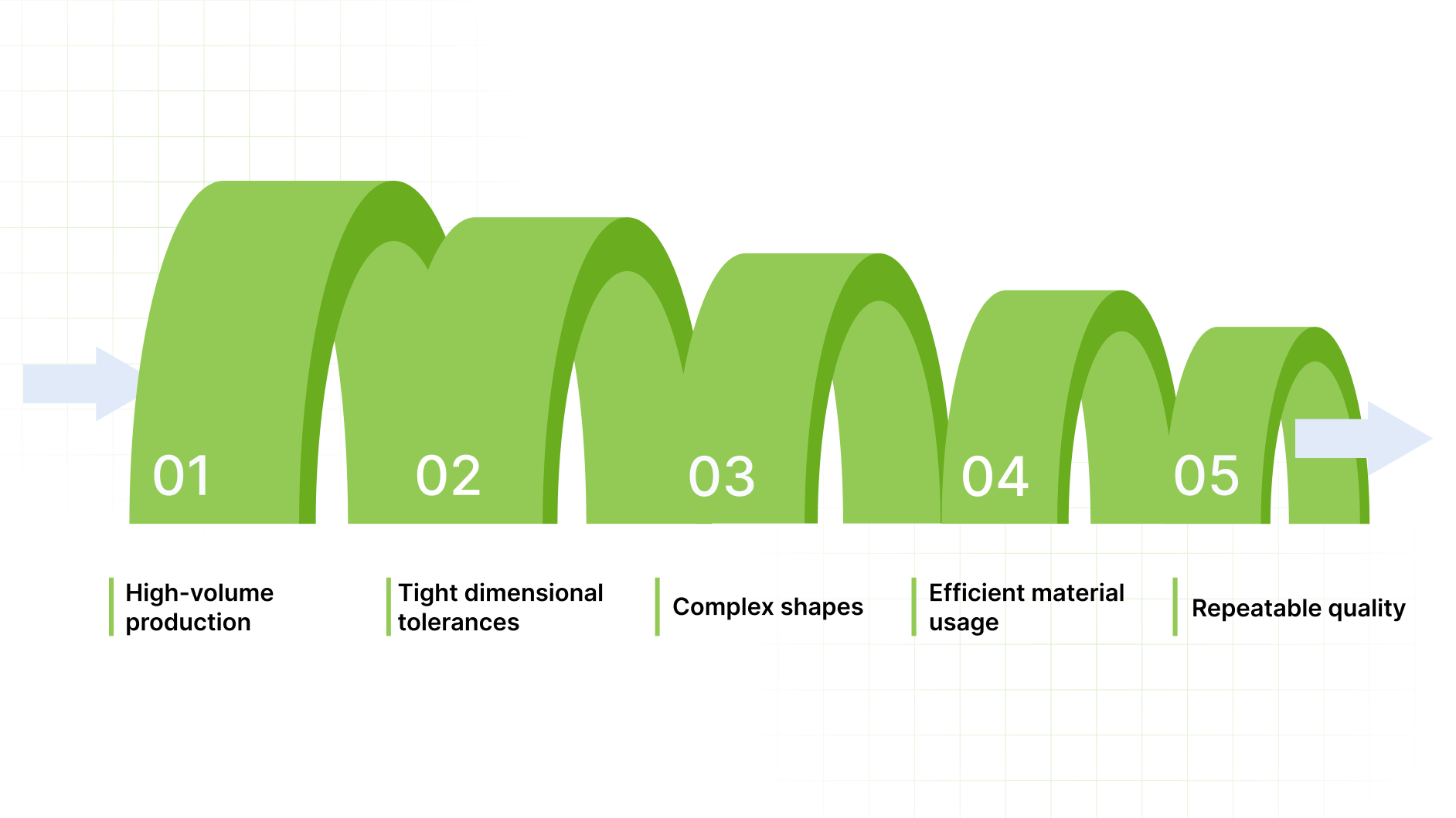
Powder metallurgy is an ideal manufacturing choice when projects demand precision, efficiency, and scalability. It delivers the greatest value when components are produced in large quantities and designed to take full advantage of the process.
Powder metallurgy is best suited when:
High-volume production is required to justify tooling and maximize cost efficiency
Tight dimensional tolerances and consistent part-to-part accuracy are critical
Complex shapes or internal features need to be produced without extensive machining
Efficient material usage and low scrap rates are important cost and sustainability factors
Repeatable quality and performance are required across thousands or millions of parts
When these conditions align, powder metallurgy offers a reliable, cost-effective solution that outperforms many traditional manufacturing methods.
How Sterling Sintered Supports Powder Metallurgy Manufacturing
Sterling Sintered Technologies is a practical example of how powder metallurgy principles are applied in real-world manufacturing. Their capabilities closely align with the processes, advantages, and applications discussed throughout this blog.
1. Proven Experience and Quality Focus
Sterling Sintered has been manufacturing custom sintered metal components since 1955 and operates under ISO 9001:2015 certification. This reflects a strong focus on consistent quality, process control, and reliable production, key strengths of powder metallurgy.
2. End-to-End Powder Metallurgy Capabilities
The company supports the complete powder metallurgy workflow, helping customers move from concept to finished part efficiently.
Custom powder metal parts in ferrous, stainless, and non-ferrous materials
Support for complex geometries and tight tolerances
In-house tooling, part design support, and production optimization.
Secondary operations, including heat treatment, impregnation, machining, and finishing
Assembly and sub-assembly services to reduce downstream manufacturing steps
These capabilities directly reflect powder metallurgy’s advantages in design flexibility, reduced machining, and scalability.
3. Broad Material and Application Support
Sterling Sintered works with a wide range of powder metallurgy materials such as iron and steel alloys, stainless steel, copper-based alloys, and speciality materials. Their components are used across multiple industries, including:
Firearms and defense
This diversity highlights how powder metallurgy supports both high-volume production and precision-driven applications.
Sterling Sintered demonstrates how powder metallurgy delivers real manufacturing value by combining material efficiency, repeatable quality, and cost-effective production. Their approach reinforces why powder metallurgy continues to be a trusted solution for modern industrial components.
Conclusion
Powder metallurgy is a proven manufacturing process that delivers precision, efficiency, and scalability across a wide range of industries. By enabling near-net-shape production, high material utilization, and consistent quality, it helps manufacturers meet demanding performance and cost requirements, especially in high-volume applications.
For companies looking to leverage these benefits, working with an experienced partner is essential. Sterling Sintered Technologies offers decades of expertise, comprehensive powder metallurgy capabilities, and a strong commitment to quality.
Contact Sterling Sintered to explore how powder metallurgy can support your next manufacturing project.
FAQs
1. What materials can be used in powder metallurgy?
Common materials include iron and steel alloys, stainless steel, copper, bronze, aluminum, and specialty alloys such as nickel- and cobalt-based materials.
2. Is powder metallurgy suitable for high-strength parts?
Powder metallurgy can produce strong, durable components, but extremely high-load or critical structural parts may be better suited to forging or wrought processes.
3. Why is powder metallurgy cost-effective for high-volume production?
Once tooling is established, powder metallurgy offers fast cycle times, minimal waste, and reduced machining, which significantly lowers per-part costs at scale.
4. Can powder metallurgy produce complex shapes?
Yes. Powder metallurgy excels at producing complex geometries, internal features, and controlled porosity that are difficult or costly to achieve with traditional methods.
5. What is a “green part” in powder metallurgy?
A green part is the compacted shape formed after pressing metal powder but before sintering. It has the final geometry but limited strength until heat-treated.