In performance-driven manufacturing, the process you choose directly shapes how a component performs in the real world. The defining characteristics of powder metallurgy give engineers a level of control that conventional casting or machining cannot match.
By forming components from compacted metal powders and bonding them through controlled sintering, powder metallurgy enables precise tuning of density, porosity, and mechanical strength. This process delivers consistent, near-net-shape parts with unique structural advantages.
Understanding these characteristics is essential for evaluating performance limits, durability, and design flexibility in powder-metallurgy components.
Key Takeaways
Almost every mechanical property in PM, from tensile strength to hardness, is a direct function of the part’s final density.
Unlike casting, where porosity is a defect, in PM, it is a functional feature used for self-lubrication and filtration.
The PM process achieves a 95% or higher material utilization rate, significantly reducing scrap and secondary machining costs.
While PM offers immense geometric freedom, it requires a "net-shape" mindset regarding wall thickness and pressing directions.
PM components provide excellent chemical uniformity, which is critical for consistent performance in magnetic and high-temperature applications.
Density-Related Properties: The Heart of PM Performance
When discussing the characteristics of powder metallurgy, density is the most critical metric you will encounter. In traditional wrought materials, density is a fixed physical constant.
In PM, density is a variable that you can control to suit your specific application. This mass per unit volume, typically expressed in g/cm^3, dictates the structural integrity of the finished part.
The Density Spectrum
Most PM structural parts have relative densities ranging from 80% to over 95%. Engineers generally categorize these into three distinct tiers:
Low Density (< 7.2 g/cm³): Primarily used for filters and self-lubricating bearings and bushings. These parts rely on interconnected porosity to hold oil or allow fluid flow.
Medium Density (7.2 – 7.4 g/cm³): The "sweet spot" for most structural components like gears and sprockets. It balances cost-effectiveness with reliable mechanical strength.
High Density (> 7.5 g/cm³): Achieved through advanced techniques like warm compaction or double-pressing. These parts approach the properties of wrought steel and are used in heavy-duty automotive applications.
Understanding Porosity and Permeability
Porosity is the percentage of void space within a PM part. It can exist as interconnected porosity (channels that reach the surface) or closed porosity (isolated pockets). For self-lubricating components, interconnected porosity acts as a built-in reservoir, using capillary action to draw oil to the surface during operation.
Permeability, on the other hand, measures how easily gases or liquids can pass through these pores. By controlling the particle size and compaction pressure, you can manufacture stainless steel filters with precise permeability to regulate pressure drops in hydraulic systems or act as flame arrestors.
Moving from the structural foundation of density, we must examine how these internal voids directly influence the mechanical strength and durability of the component.
Mechanical Properties: Strength, Ductility, and Hardness
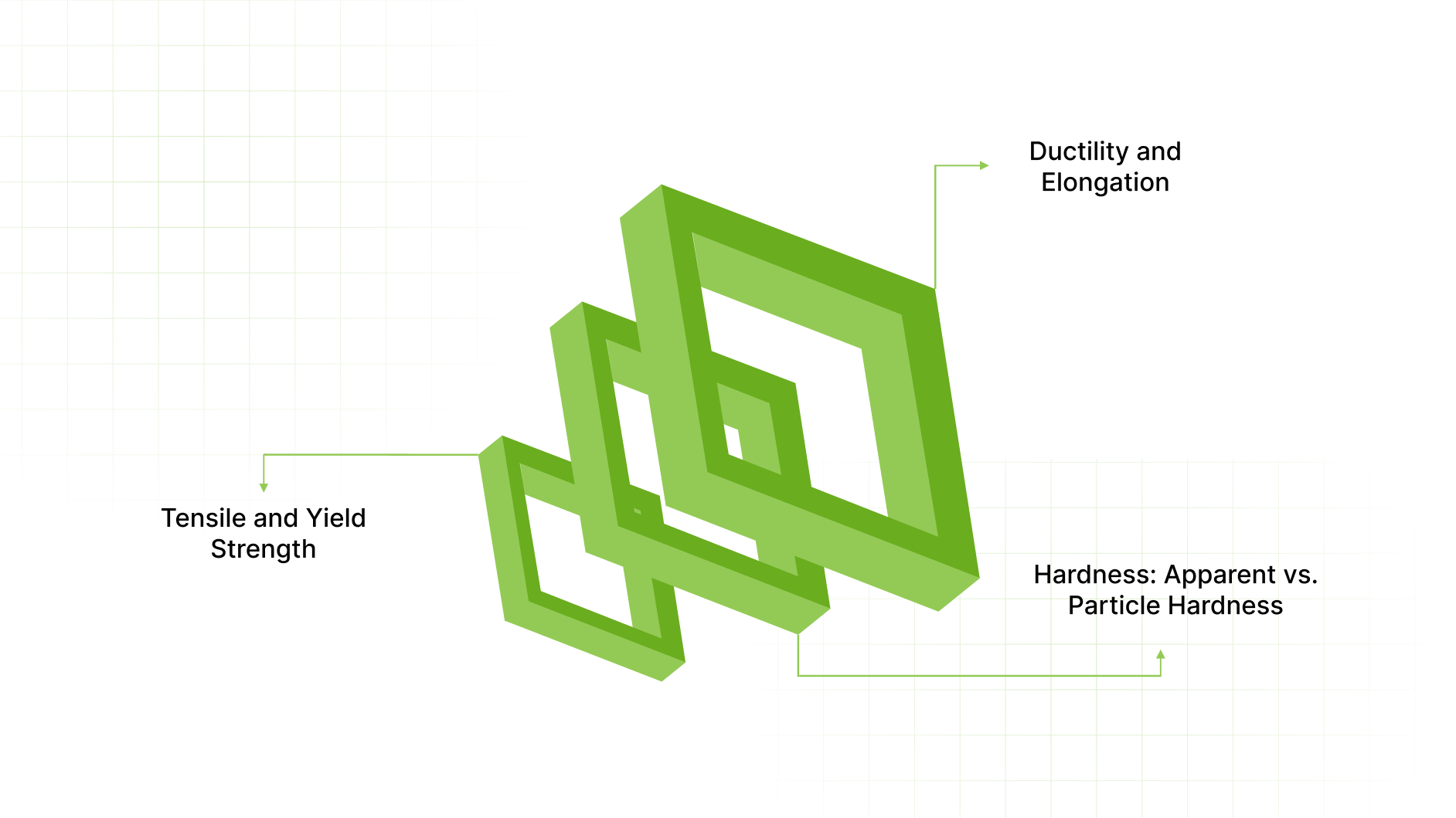
The mechanical characteristics of powder metallurgy are inherently linked to the bonding between particles during the sintering phase.
Unlike a solid block of steel, a PM part’s strength is determined by the "necking" process, where atoms diffuse across particle boundaries to form a cohesive matrix.
Tensile and Yield Strength
In PM materials, tensile strength follows a near-linear relationship with density. As you reduce the void space, the effective load-bearing area increases. For example, a standard iron-copper-carbon steel (FC-0208) might show a yield strength of 240 MPa at medium density, but this can climb significantly if the density is boosted through secondary operations like repressing.
Ductility and Elongation
Ductility, the ability of a material to deform before fracturing, is where PM differs most from wrought metals. Because pores act as "stress concentrators," elongation in ferrous PM parts is typically lower, often under 10%.
However, this is not a limitation for most structural designs that prioritize rigidity and wear resistance. If your application requires high ductility, opting for stainless steel or specialized sintering cycles can increase elongation to the 15-20% range.
Hardness: Apparent vs. Particle Hardness
In PM, you must distinguish between two types of hardness:
Apparent Hardness: Measured using a standard Rockwell or Vickers test over a large area. It accounts for both the metal and the pores, representing the part's overall resistance to indentation.
Particle Hardness: The actual hardness of the individual metal grains. This is what determines the wear resistance of the part. Even if a part has "low" apparent hardness, its particle hardness can be extremely high, providing excellent service life in abrasive environments.
Physical Properties: Beyond Structural Strength
While mechanical stats are vital, the physical characteristics of powder metallurgy offer unique advantages that other processes simply cannot match. From noise reduction to magnetic efficiency, the "porous-yet-solid" nature of sintered metal is a design feature in itself.
Surface Finish and Reflectivity
One of the inherent benefits of PM is its exceptional surface finish. Since the parts are formed against precision-ground tool steel dies, the resulting surface is often smoother than what can be achieved with standard milling.
Standard PM parts typically achieve a surface finish of 0.80 to 1.20 µm (RMS). This smoothness reduces friction in moving assemblies and often eliminates the need for expensive polishing steps.
Sound Dampening and Vibration Absorption
Have you ever noticed how wrought steel gears produce a high-pitched "ring" during operation?
PM parts are different. The residual porosity within the material acts as a built-in shock absorber, dampening vibrations and significantly reducing noise. This makes PM the preferred choice for gears in home appliances and automotive cabins where "NVH" (Noise, Vibration, and Harshness) levels are a critical consumer metric.
Corrosion Resistance and Magnetic Properties
In environments where moisture or chemicals are present, the porosity of PM can be a double-edged sword. While stainless steel PM provides excellent resistance, the pores can trap corrosive media.
To combat this, parts can be resin-impregnated to seal the pores and provide a barrier against oxidation. In magnetic applications, the chemical homogeneity of iron and steel powders allows for superior magnetic flux and reduced eddy current losses compared to traditional lamination methods.
Physical properties define how the part interacts with its environment, but the geometry of the part is governed by the physics of the compaction process.
Shape and Design Limitations: Engineering for the Press

Designing for powder metallurgy requires an understanding of how metal powder behaves under pressure. Unlike a liquid that fills a mold, metal powder does not flow "hydraulically." It moves primarily in the direction of the pressing force, which introduces specific geometric constraints.
The "Net-Shape" Constraints
To maximize the cost-savings of PM, you should aim for a "net-shape" design, one that requires zero secondary machining. Key limitations include:
Wall Thickness: As a general rule, walls should be no thinner than 1.52 mm (0.060 inches). Thinner walls make it difficult for the powder to fill the die consistently and can lead to fragile "green" parts.
Length-to-Diameter Ratio: The ideal ratio for a PM part is usually 3:1. If a part is too long and thin (approaching 8:1), the friction between the powder and the die walls prevents uniform compaction, resulting in a density gradient where the center of the part is weaker than the ends.
Undercuts and Holes: Holes parallel to the pressing direction (using core rods) are easy and inexpensive. However, holes or undercuts perpendicular to the pressing direction generally cannot be pressed and must be added via secondary machining.
Drafts and Radii
Unlike casting, where a "draft" (taper) is required to remove the part from the mold, PM dies are precision-engineered to eject the part without a taper.
In fact, adding a draft can actually slow down production. What is essential, however, is a generous radius on all corners. Sharp corners are stress concentrators for the part and points of failure for the expensive tool steel dies.
Powder Metallurgy Defects: Causes and Prevention
Even with a perfect design, the manufacturing process variables can introduce defects. Recognizing these early in the prototype stage is essential for maintaining high-quality standards.
Defect Type | Primary Cause | Mitigation Strategy |
Lamination Cracking | Excessive air entrapment or uneven ejection pressure. | Optimize compaction speed and use tapered die exits. |
Blowouts | Rapid heating during sintering causing internal gases to expand. | Implement a controlled "delubing" (de-waxing) cycle at lower temperatures. |
Density Variation | Poor powder flow or improper lubrication within the die. | Adjust the particle size distribution or increase lubricant percentage. |
Sintering Distortion | Uneven heating or improper support for complex geometries. | Use sintering trays (setters) to provide structural support during the furnace cycle. |
Most defects in PM stem from the "green" stage, the moment after pressing but before the part is "baked" (sintered).
Sterling Sintered Technologies mitigates these risks through rigorous powder analysis and precision-controlled furnace atmospheres, ensuring that every batch of iron, steel, or bronze components meets the exact mechanical specifications.
While defects often occur at the macro scale, their origins are almost always found at the micro scale, specifically in the characteristics of the metal particles themselves.
Particle Characteristics: The Micro-Science of PM
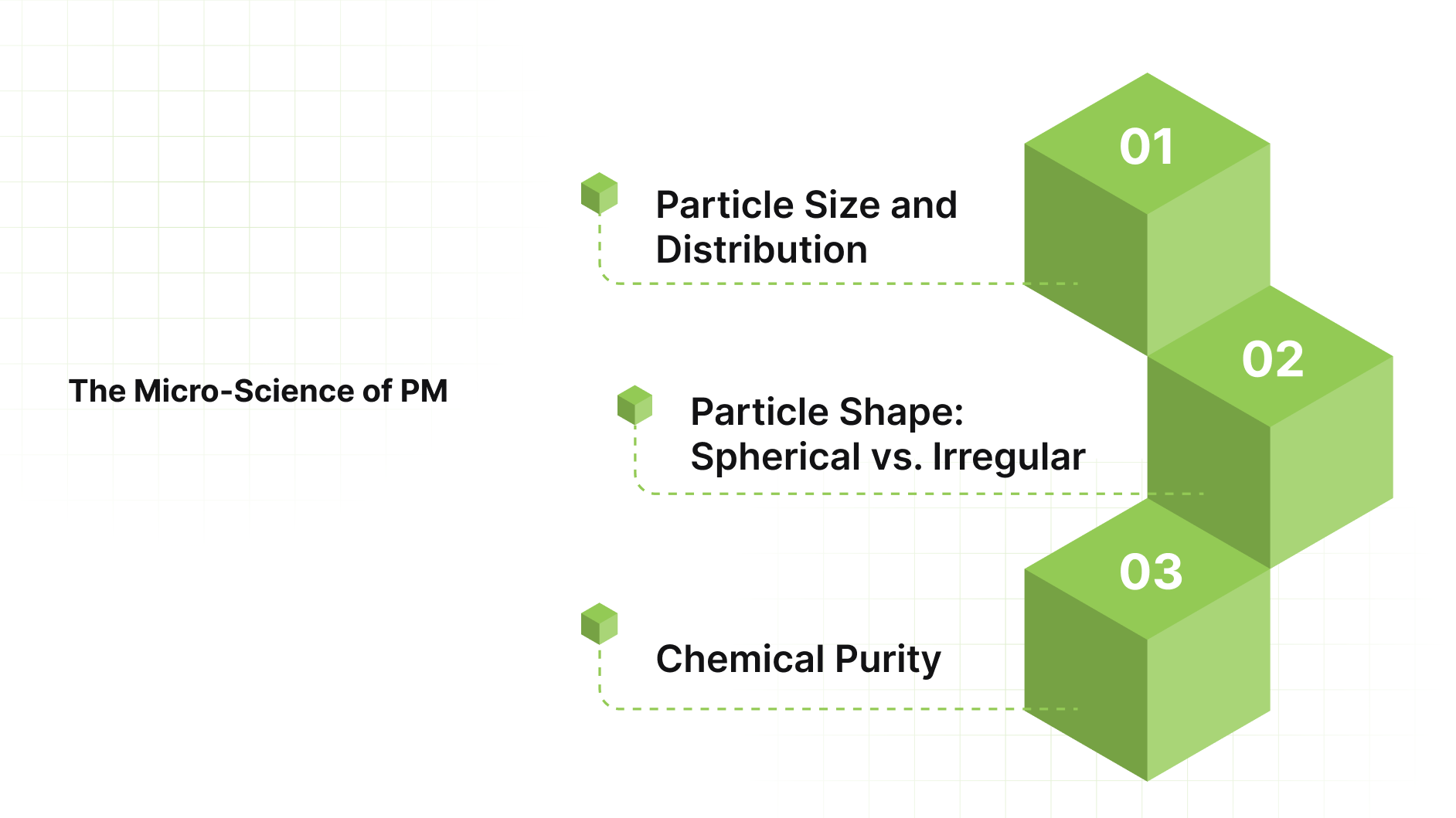
The final characteristics of powder metallurgy are a reflection of the raw powder's DNA. The size, shape, and chemistry of the particles determine how the powder flows into the die and how well it bonds during sintering.
Particle Size and Distribution
If all particles were the same size, there would be significant gaps between them (imagine filling a jar with only golf balls). A "distribution" of sizes allows smaller particles to fill the voids between larger ones, increasing the "apparent density" of the powder. This leads to better packing and higher final strength.
Finer Powders: Increase surface area, leading to faster sintering and higher strength, but can negatively impact flow rate.
Coarser Powders: Flow more easily into complex dies but may require higher sintering temperatures to achieve full density.
Particle Shape: Spherical vs. Irregular
The method used to produce the powder determines its shape. Atomization (spraying molten metal with gas or water) typically produces spherical or slightly irregular grains. These are excellent for flow but have less "green strength" (the interlocking of particles before sintering).
Oxide Reduction produces sponge-like, irregular particles that "hook" together during pressing, creating a very strong green compact that is easy to handle.
Chemical Purity and Microstructure
The purity of the metal powder is paramount. Even trace amounts of oxygen or silica can create brittle phases at the particle boundaries, sabotaging the part's ductility.
By engineering the microstructure, the arrangement of atoms within each grain, metallurgists can tailor properties like magnetic permeability or high-temperature creep resistance.
Conclusion
The characteristics of powder metallurgy offer a unique "material-by-design" approach that is unmatched by traditional manufacturing. By manipulating density, porosity, and particle chemistry, you can create parts that are not only cost-effective but functionally superior.
Whether you are leveraging the self-lubricating properties of bronze for a long-life bearing or the vibration-dampening nature of sintered steel for a high-speed gear, the science of PM is a powerful tool in any engineer's arsenal.
As you look toward the future of your product line, consider how the net-shape capabilities and material efficiency of PM can streamline your supply chain.
At Sterling Sintered Technologies, we specialize in turning these metallurgical properties into high-performance realities.
From initial design consulting to advanced secondary operations, we ensure that your components aren't just parts, they are precision-engineered solutions.
FAQs: Characteristics of Powder Metallurgy
1. How does density affect the cost of a PM part?
Generally, higher density requires more expensive raw materials (finer powders), higher compaction pressures (larger presses), and sometimes secondary pressing steps. Therefore, cost increases as you move from low-density bearings to high-density structural components.
2. Can PM parts be heat-treated like wrought steel?
Absolutely. PM parts made from iron and steel alloys can be case-hardened, through-hardened, or tempered. However, the porosity of the part must be considered, as it affects the rate of heat transfer and the absorption of quenching oils.
3. Is powder metallurgy sustainable?
Yes, PM is one of the most sustainable manufacturing processes. It achieves over 95% material utilization (minimal scrap) and often uses recycled metal powders. Furthermore, it requires less energy than melting and casting entire blocks of metal.
4. What is "Green Strength" in powder metallurgy?
Green strength refers to the mechanical integrity of a part after it has been pressed but before it is sintered. It is the result of the mechanical interlocking of irregular metal particles. High green strength is vital for handling and transporting parts to the sintering furnace without breakage.
5. Why are PM gears quieter than machined gears?
The residual porosity in a PM gear acts as an acoustic dampener. It absorbs the energy of the impact as gear teeth engage, whereas a solid machined gear reflects that energy as high-frequency noise.