In high-volume manufacturing, final assembly is often where inefficiencies quietly surface. A machined part that passes inspection can still fail during assembly due to burrs, misalignment, thermal variation, or incorrect torque application.
These issues usually stem from disconnected fabrication and assembly processes rather than part quality alone.
A reliable assembly outcome requires a structured, engineering-led approach. Focusing on part cleanliness, precision measurement, controlled environments, and Design for Assembly (DFA) principles helps reduce rework, minimize scrap, and ensure components function together exactly as intended.
Key Takeaways
Microscopic swarf or residual cutting fluids can compromise fit and lead to premature component wear or corrosion.
Simplifying part geometries and reducing fastener counts during the design phase significantly lowers the risk of human error.
Utilizing calibrated instruments and Statistical Process Control (SPC) ensures that tolerance stack-ups are identified before they shut down an assembly line.
Outsource complex sub-assemblies to a technical partner to reduce inventory risk and internal labor costs.
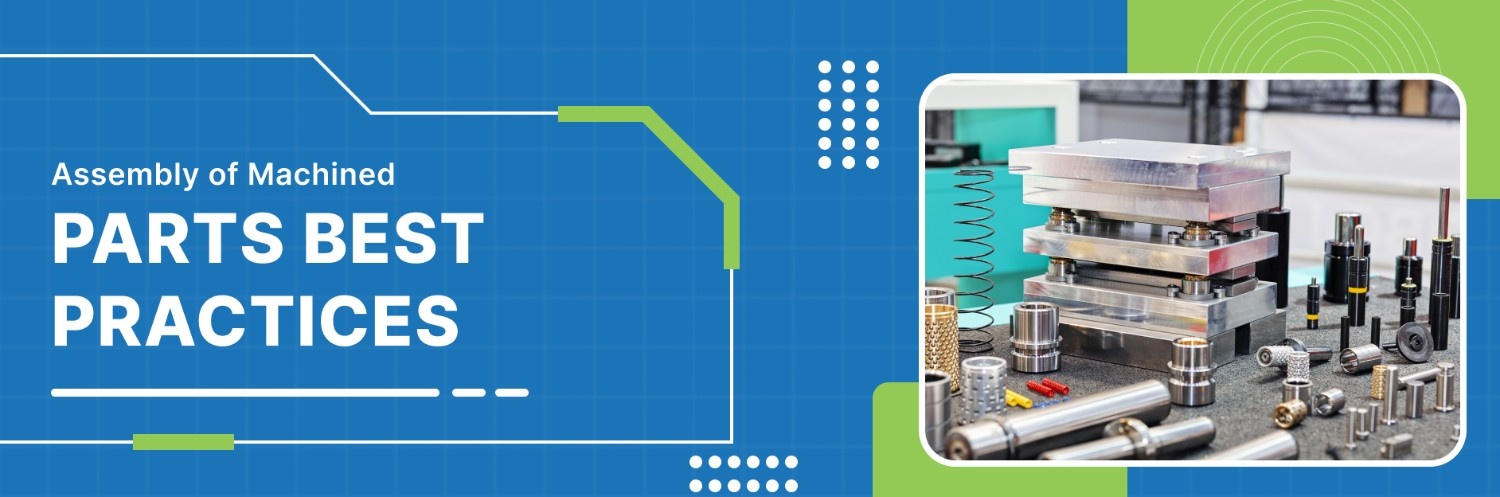
Best Practices for High-Precision Assembly of Machined Parts
High-precision assembly requires more than just fitting components together; it necessitates a rigorous adherence to metallurgical cleanliness and dimensional synchronization.
By implementing these industry-standard best practices, manufacturers can mitigate the risks of premature wear and catastrophic mechanical failure.
At Sterling Sintered Technologies, we emphasize these protocols during our value-added assembly services to ensure that every net-shape part functions perfectly within its larger mechanical system.
Preparatory Work: The Metallurgy of Cleanliness
The most common failure in the assembly of machined parts does not occur during the press-fit or fastening stage; it begins with improper preparation. For high-precision components, especially those made from Stainless Steel (300 & 400 series) or iron alloys, "clean" is a functional specification, not a cosmetic one.
Cleaning and Descaling
Every part ejected from a machining center carries a residue of aqueous or oil-based coolants and microscopic chips (swarf). If these are not removed through a multi-stage process, they act as abrasives within the final assembly.
Ultrasonic Cleaning: Essential for parts with blind holes or internal splines. High-frequency sound waves create microscopic cavitation bubbles that dislodge contaminants from occluded surfaces.
Vapor Degreasing: Uses solvent vapors to dissolve petroleum-based lubricants without leaving water spots, which is critical for parts bound for secondary thermal treatments.
Deburring and Surface Finishing
A single burr on a gear tooth can prevent a perfect mesh, leading to vibration and gear-train noise. In the automotive and lawn & garden industries, vibratory finishing is used to ensure all edges are radiused consistently.
For technical partners like Sterling Sintered Technologies, this phase is often integrated into the secondary operations, providing assembly-ready parts that bypass the need for internal deburring departments.
Assembly Process Control: From Quality Control to SPC
Maintaining consistency in a production run that spans 500,000 units per week requires more than a "go/no-go" check at the end of the line. It requires process-level control.
Implementation of Whole-Process Quality Control
Quality control must be embedded into the assembly sequence. This involves identifying Critical-to-Quality (CTQ) dimensions, such as the concentricity of a bronze bushing within a housing, and monitoring them in real-time.
Statistical Process Control (SPC): By tracking dimensional trends using control charts, engineers can detect "tool drift" or machine wear before parts fall out of tolerance.
ISO 9001 Integration: Standardized workflows ensure that every operator follows the exact same sequence of press-fitting, lubrication, and fastening, regardless of the shift or site.
Precision Measurement and Tooling
In the assembly of machined parts, you cannot manage what you cannot measure. Precision measurement tools serve as the final gatekeeper against tolerance stack-up, the cumulative error that occurs when multiple components are assembled.
Essential Metrology Tools
Coordinate Measuring Machines (CMM): Used to verify complex geometries and multi-level parts. For high-volume OEMs, CMM data provides the metallurgical "proof of life" for critical batches.
Bore Gages and Micrometers: These tools are calibrated daily to ensure that interference fits (where a part is slightly larger than the hole it is pressed into) are achieved within microns.
Go/No-Go Gauges: These are used for rapid, high-volume verification on the factory floor, ensuring that every internal spline or thread meets the required fit class.
Selection of Task-Specific Tools
Using a generic wrench where a calibrated torque driver is required is a recipe for joint failure. Tooling must be matched to the mechanical requirements of the part.
For instance, brass components used in electrical or plumbing assemblies require non-marring tools to prevent surface damage that could lead to stress corrosion cracking.
Ensuring Proper Alignment and Fastening
Misalignment is the leading cause of mechanical friction and heat generation. When parts are not perfectly oriented, fasteners may cross-thread, and rotating components will experience uneven wear.
Correcting Component Misalignment
Design features such as chamfers and lead-in radii are essential for "self-aligning" parts during assembly. By incorporating Design for Manufacturability (DfM) refinements, engineers can ensure that parts only fit together in the correct orientation, a process known as Poka-Yoke (error-proofing).
Selection of Fasteners
The choice of fasteners must account for the material density and environmental exposure. For example, fastening a stainless steel bracket to an iron frame requires an understanding of galvanic corrosion.
In many cases, replacing separate fasteners with integrated features, like coining or sizing, can simplify the supply chain and reduce the part count.
Best Practices in Torque Application
The integrity of an assembly of machined parts often rests on the clamping force provided by threaded fasteners. Improper torque, whether too high or too low, can lead to catastrophic failures.
The Physics of Torque
Torque is a proxy for bolt tension. If a bolt is under-torqued, the joint may loosen under vibration (a common issue in the lawn and garden industry). If over-torqued, the bolt may enter the plastic deformation zone, eventually snapping or stripping the internal threads of the machined part.
Calibrated Torque Wrenches: Must be used for all critical joints. These tools should be part of a regular calibration schedule to maintain ISO 9001 compliance.
Lubrication Constants: Engineers must account for the "K-factor" (friction coefficient). A dry bolt and a lubricated bolt will provide vastly different clamping forces at the same torque setting.
Assembly Environment: Cleanliness and Control
A world-class assembly of machined parts cannot happen on a dirty floor. The environment must be as precisely controlled as the machines that fabricate the parts.
Maintaining a Controlled Environment
Climate Control: Thermal expansion is a major factor in precision assembly. If a part is machined at 70°F but assembled in a 90°F warehouse, the dimensions will shift. Maintaining a consistent temperature prevents these "phantom" tolerance issues.
Static and Dust Control: For sensitive assemblies, such as those in medical diagnostic equipment, a static-free (ESD) and dust-free environment is mandatory to prevent contamination that could interfere with signal integrity or mechanical movement.
Conclusion
The assembly of machined parts is a technical discipline that requires a holistic view of the manufacturing lifecycle.
From the initial descaling of raw components to the precise application of torque on the final fastener, every step must be governed by data and engineering utility.
For many OEMs, the most effective "best practice" is to reduce the complexity of the assembly itself.
By leveraging powder metallurgy to create complex, net-shape geometries and utilizing a single technical partner for both fabrication and sub-assembly, manufacturers can eliminate fragmented supply chains and focus on what matters most: the performance of the final product.
Would you like to reduce your internal labor costs and simplify your procurement process?
Contact Sterling Sintered Technologies to learn how our single-source sub-assembly and DfM consultation can optimize your high-volume production runs.
FAQs: Assembly of Machined Parts
1. What is the biggest challenge in high-volume assembly?
The biggest challenge is tolerance stack-up. When each individual part is at its limit of tolerance, the final assembly may not fit. This is managed through strict Statistical Process Control and DfM refinements to ensure the "nominal" dimension is always targeted.
2. How does material selection impact assembly?
Different materials have different coefficients of thermal expansion and friction. For instance, Bronze bearings are often selected for their self-lubricating properties, which simplifies assembly by eliminating the need for manual greasing during the build process.
3. Why is Design for Manufacturability (DfM) important for assembly?
DfM is about making the part "friendly" for both fabrication and assembly. It reduces production steps, eliminates the need for expensive secondary machining, and ensures that parts can be assembled quickly and without error.
4. Can powder metallurgy parts be assembled with traditional machined parts?
Yes. High-precision PM parts are designed to be "net-shape" or "near-net shape," meaning they are often drop-in replacements for machined parts, offering the same tolerances but with significant cost savings and better material utilization.