The automotive industry today is under constant pressure to do more with less, lighter vehicles, higher performance, tighter tolerances, and rising material costs. Traditional manufacturing methods often struggle to balance these competing demands without increasing waste or complexity.
This is where the applications of powder metallurgy in the automobile industry have become a practical solution rather than an alternative.
By replacing material-intensive legacy components with sintered, near-net-shape parts, powder metallurgy enables automakers to reduce weight, control costs, and maintain structural integrity across both internal combustion and electric powertrains. From precision valve systems to advanced motor components, powder metal delivers consistent performance with minimal waste.
In this blog, we explore how powder metallurgy is applied across modern vehicle systems, why it continues to gain adoption, and how it supports efficiency, sustainability, and scalable automotive production.
Key Takeaways
Powder metallurgy (PM) typically utilizes over 95-98% of the raw material, drastically reducing scrap compared to machining.
Advanced aluminum and titanium powders can reduce component weight by up to 50%, a critical factor for extending EV battery range.
The process allows for the creation of unique alloys and self-lubricating microstructures that eliminate the need for external oiling in critical joints.
For high-volume automotive production, PM reduces the need for expensive secondary machining, lowering the total cost per part by 15-25%.
Emergence of SMCs: Soft Magnetic Composites (SMCs) are revolutionizing EV motor design by providing 3D magnetic flux paths and reducing energy losses.
Overview of Powder Metallurgy in the Automotive Industry
Powder metallurgy plays a foundational role in modern automotive manufacturing by enabling the production of complex, high-strength components with tight dimensional control. Unlike conventional casting or forging, PM allows engineers to tailor material density, porosity, and alloy composition to meet specific performance requirements.
Here are the key advantages of powder metallurgy in automotive applications:
Near-net-shape production that minimizes secondary machining and material waste
High-dimensional accuracy and repeatability, ideal for mass production
Material efficiency, using most of the raw powder with minimal scrap
Design flexibility, allowing complex geometries and integrated features in a single part
Controlled porosity, enabling self-lubricating and weight-optimized components
Cost-effective scalability for high-volume automotive manufacturing
Because of these advantages, powder metallurgy is widely used across critical vehicle systems, including engines, transmissions, chassis components, and auxiliary mechanisms, where performance, consistency, and cost control are essential.
Powder Metallurgy Applications in Automotive Manufacturing
Powder metallurgy has transitioned from a niche solution for simple washers to a cornerstone of automotive structural engineering.
By leveraging advanced sintering techniques, automakers can consolidate multiple components into a single complex part, reducing assembly time and potential failure points.
This versatility ensures that PM remains relevant across both traditional internal combustion engines and the latest electric propulsion systems.
Engine Components: Powering Efficiency and Precision
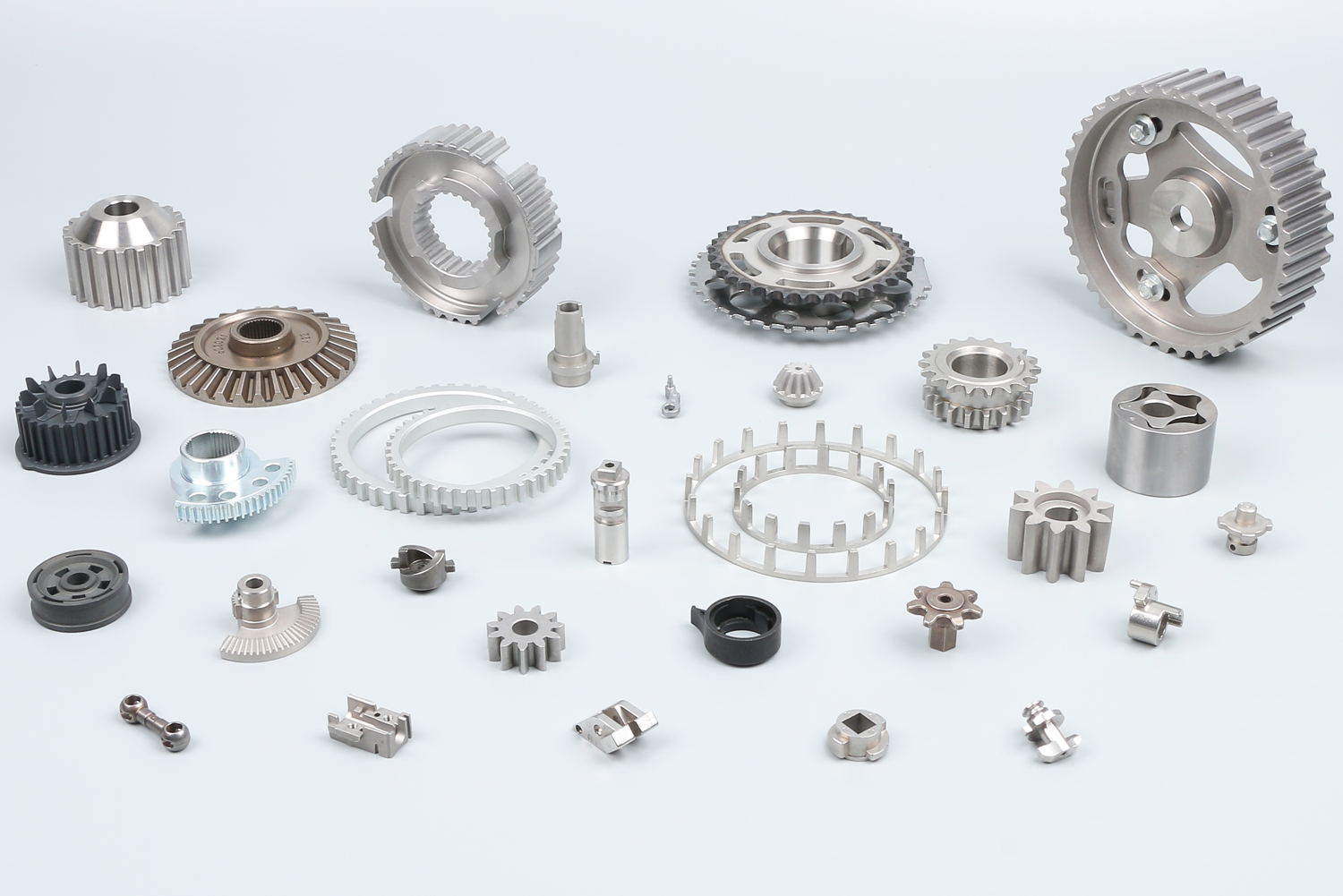
The modern engine is a high-RPM environment where thermal expansion and mechanical fatigue are constant threats. Powder metallurgy allows engineers to use materials that can withstand these stresses while reducing the overall mass of the moving parts.
1. Connecting Rods and Main Bearing Caps
Perhaps the most iconic application is the powder-forged connecting rod. By using a "fracture-splitting" technique on a PM part, manufacturers achieve a perfect fit between the rod and the cap, which is superior to traditional machined mating surfaces. This reduces vibration and extends engine life.
2. Variable Valve Timing (VVT) Systems
The VVT system is critical for optimizing fuel consumption. The stator and rotor in these systems are almost exclusively produced via PM.
These parts require extremely tight tolerances (often within microns) and complex internal shapes that would be prohibitively expensive to machine from solid bar stock.
3. Camshaft Lobes and Valve Seats
Instead of casting a single, heavy camshaft, many manufacturers now use "assembled camshafts." In this design, individual sintered lobes, made from high-alloy steel powders, are pressed onto a hollow steel tube.
Moving beyond the combustion chamber, the transmission system utilizes PM to manage the transfer of power with minimal energy loss.
Transmission and Drivetrain: Handling the Torque

The transmission is a maze of gears, hubs, and carriers that must interact seamlessly. The applications of powder metallurgy in the automobile industry for drivetrains focus on wear resistance and noise, vibration, and harshness (NVH) reduction.
1. Synchronizer Hubs and Sleeves
In manual and dual-clutch transmissions (DCT), synchronizer hubs are complex parts with internal and external splines. Producing these through PM eliminates multiple broaching and milling steps. Sintered hubs also offer better damping properties, which help in reducing gear shift noise.
2. Planetary Gear Carriers
Planetary gear sets are the heart of automatic transmissions. PM allows for the production of planetary carriers that are lighter than their cast-iron predecessors.
3. Differential Gears
The side gears and bevel gears within a vehicle’s differential are frequently made using PM steel powders. These parts benefit from the uniform microstructure of the sintered metal, ensuring that there are no "soft spots" or casting defects that could lead to catastrophic gear failure under heavy loads.
Synchronizing these movements requires precision timing, another area where powdered metal excels.
Sprockets and Timing Systems
Timing sprockets and pulleys are essential for ensuring that the engine’s valves and pistons move in perfect harmony. Using powder metallurgy for gears and sprockets offers a unique advantage: the ability to integrate weight-saving holes and complex tooth profiles into the mold itself.
Material Strength: Most automotive sprockets are made from iron and steel powders alloyed with nickel or molybdenum to ensure they can withstand the constant tension of the timing chain.
NVH Benefits: Sintered sprockets have natural vibration-damping qualities that make them quieter than their fully dense wrought counterparts.
Where there is motion, there is friction; powder metallurgy solves this through "self-lubricating" material science.
Bearings and Bushings: The Science of Friction
The automotive industry relies on thousands of small joints that must move freely for years without maintenance. Sintered bearings and bushings are a cornerstone of this requirement.
The Self-Lubricating Mechanism
By controlling the sintering process, manufacturers can create a network of interconnected pores within the metal. These pores are then vacuum-impregnated with specialized lubricants. As the shaft rotates, heat and centrifugal force draw the oil to the surface, creating a protective film. When the motion stops, the oil is reabsorbed into the metal.
Applications: Wiper motors, seat adjustment mechanisms, starter motors, and cooling fan assemblies.
Materials: Typically made from bronze or iron-bronze mixtures for a balance of strength and low friction.
While some parts manage friction, others must manage the corrosive heat of the exhaust system.
Exhaust and Emission Systems: Tackling Extreme Heat
Exhaust components operate in one of the harshest environments in a vehicle, subjected to temperatures exceeding 800°C and constant exposure to road salt and moisture.
Sensor Bosses and Flanges: Oxygen sensors and NOx sensors must be mounted securely to the exhaust pipe. PM stainless steel sensor bosses provide the necessary corrosion resistance and thermal stability.
Turbocharger Components: The vanes and spacer rings in variable geometry turbochargers (VGT) are increasingly made from high-temperature PM alloys. These parts maintain their shape and strength even when glowing red-hot, ensuring the turbocharger operates efficiently.
Safety systems, particularly brakes, represent a non-negotiable area for reliability where PM plays a critical role.
Brake Systems: Reliability and Safety
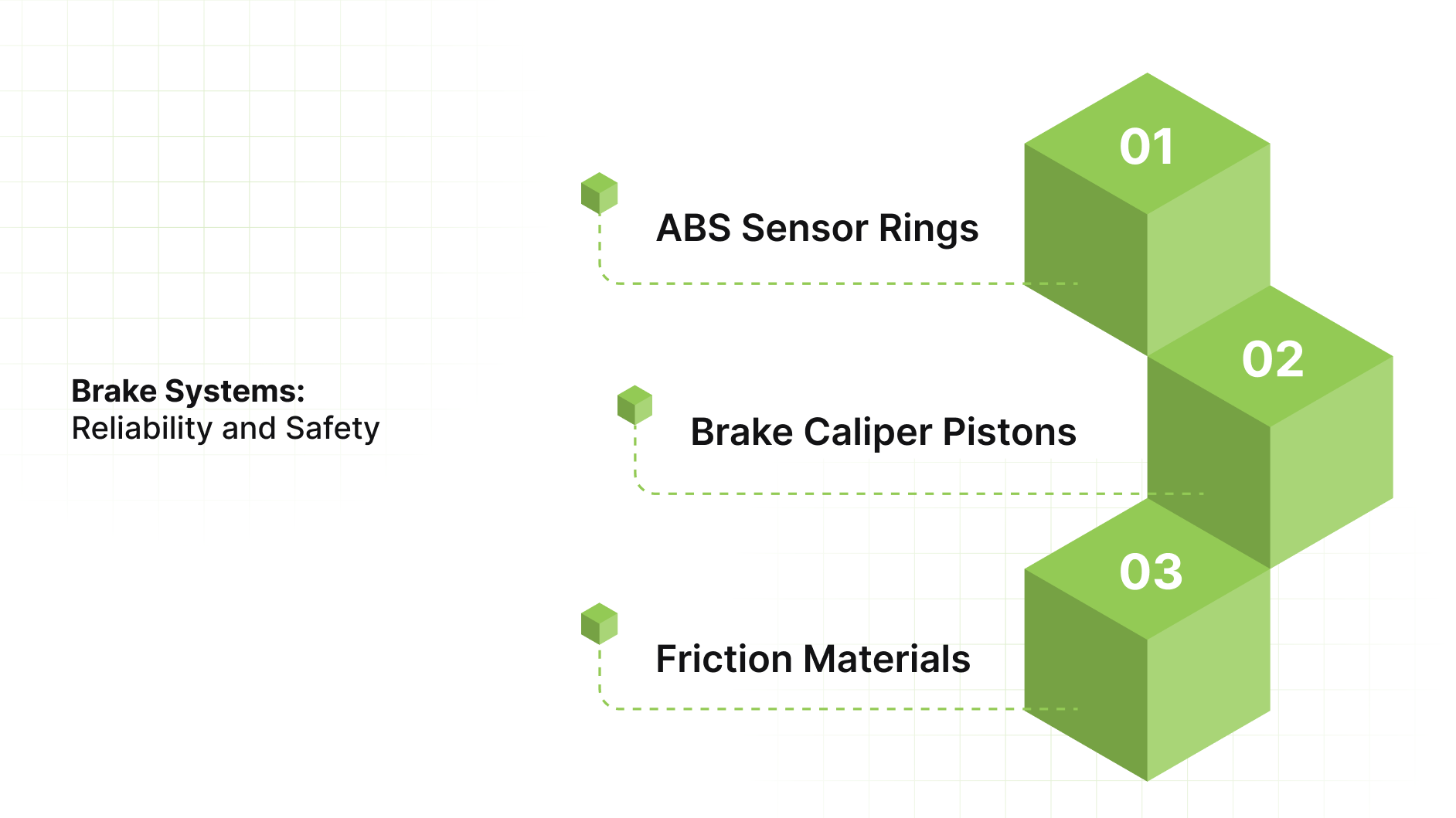
In the realm of braking, the applications of powder metallurgy in the automobile industry are focused on consistency and high-friction performance.
ABS Sensor Rings: The tone wheels or encoder rings used by Anti-lock Braking Systems (ABS) are often made from sintered steel. These rings require precise tooth geometry to provide an accurate signal to the vehicle's computer.
Brake Caliper Pistons: Aluminum PM pistons are gaining popularity because they are lightweight and resist the corrosion that often plagues traditional steel pistons, helping to prevent brake "drag" or seizing.
Friction Materials: While the pads themselves are a composite, the backing plates can be manufactured using PM to create a textured surface that improves the mechanical bond between the plate and the friction material.
Fuel and oil delivery are the "circulatory system" of the vehicle, requiring pumps that can maintain pressure for the life of the car.
Fuel and Oil Systems: Optimized Pumping
Efficiency in an engine is often limited by parasitic losses, the energy the engine spends just to keep itself running. PM oil pumps are a major solution to this problem.
G-Rotors (Gerotors): The inner and outer rotors of an oil pump are classic applications of powder metallurgy in the automobile industry. The complex, trochoidal shapes of these rotors are nearly impossible to machine efficiently.
Sintering them allows for perfect meshing, which maintains high oil pressure even at low idle speeds.
Variable Displacement Pumps: Modern engines use variable oil pumps to reduce energy consumption at high speeds. The eccentric rings and vanes in these pumps are manufactured using PM to ensure high wear resistance against the sliding friction of the pump vanes.
Materials: The Foundation of Automotive Performance
Choosing the right material is a balance of weight, cost, and mechanical requirements. Sterling Sintered Technologies works with a wide array of materials to meet these diverse needs.
Material Group | Common Automotive Applications | Key Properties |
Iron & Steel | Connecting rods, gears, VVT parts | High strength, low cost, heat treatable. |
Stainless Steel | Exhaust flanges, sensor bosses | Corrosion and oxidation resistance. |
Bronze | Self-lubricating bushings | Excellent wear resistance, low friction. |
Aluminum | Cam caps, sprockets, brake pistons | Significant weight reduction, good thermal conductivity. |
Soft Magnetic | EV motor stators, ABS sensors | High magnetic permeability, low energy loss. |
To enhance these properties, parts often undergo secondary operations such as resin impregnation (to make parts pressure-tight), steam treating (to increase surface hardness), or CNC machining for ultra-high-tolerance fits.
Future Trends in Powder Metallurgy for Automotive Applications
The future of powder metallurgy in the automotive industry extends well beyond conventional engine components. As vehicle platforms evolve, PM continues to adapt to emerging requirements across electrification, hybrid systems, and sustainability-focused design.
Key trends shaping the future include:
Electric and Hybrid Vehicles: Soft Magnetic Composites (SMCs) are increasingly used in motors, sensors, and actuators to improve efficiency and reduce energy losses.
Lightweighting Initiatives: Expanded use of aluminum and advanced alloy powders to offset battery weight and improve overall vehicle range.
Sustainability Goals: High material utilization and recyclability make PM a preferred choice for manufacturers targeting lower environmental impact.
Integrated Component Design: Consolidation of multiple parts into single sintered components to simplify assembly and improve reliability.
These trends reinforce powder metallurgy’s role as a future-ready manufacturing technology.
Sterling Sintered Technologies: Advancing Automotive Powder Metallurgy
Sterling Sintered Technologies (SST) is a trusted partner for automotive manufacturers seeking precision-engineered powder metallurgy components at scale. With deep expertise in material science, tooling, and controlled sintering processes, SST supports both legacy vehicle platforms and next-generation automotive systems.
SST specializes in producing high-performance sintered parts such as gears, sprockets, bushings, structural components, and self-lubricating solutions designed for durability and consistency. Their in-house capabilities, from custom tool development to secondary operations like heat treatment, impregnation, and precision machining, ensure tight quality control across the production lifecycle.
By combining advanced materials with efficient near-net-shape manufacturing, Sterling Sintered Technologies helps automotive OEMs and Tier suppliers reduce waste, improve part reliability, and maintain cost stability in an increasingly demanding market.
Conclusion
The applications of powder metallurgy in the automobile industry are no longer a "niche" alternative; they are a fundamental requirement for the high-performance, lightweight, and cost-effective vehicles of today and tomorrow.
Whether it is a gear that survives millions of shifts or a bearing that keeps a wiper motor silent, sintered metal is everywhere.
As the industry pivots toward electrification and autonomous driving, the demand for specialized magnetic materials and complex structural components will only grow. Powder metallurgy offers the unique ability to adapt, providing the materials of the future through the precision of the present.
At Sterling Sintered Technologies, we specialize in bringing these complex automotive designs to life.
From material selection to final secondary operations, we provide the expertise needed to navigate the evolving automotive landscape. Contact us today to see how our powder metallurgy solutions can optimize your production.
FAQs: Powder Metallurgy in the Automotive Industry
1. Are powder metal parts strong enough for high-torque applications?
Absolutely. Through modern alloy development and techniques like Sinter-Forging, PM parts can reach densities and strengths that rival or exceed traditional wrought steel. They are used in heavy-duty truck transmissions and high-stress engine components every day.
2. How does powder metallurgy help with vehicle weight reduction?
PM allows for the use of lightweight materials like aluminum and the creation of "hollow" or "lattice" geometries that are impossible to cast. Furthermore, because PM parts are more precise, you can design thinner-walled components without fearing structural failure.
3. Is powder metallurgy used in electric vehicles?
Yes. Beyond the standard structural parts (like door latches and seat gears), EVs use Soft Magnetic Composites (SMCs) in their electric motors and advanced actuators for "Shift-by-Wire" and "Brake-by-Wire" systems.
4. Can powder metallurgy parts be recycled?
Yes. PM parts are highly sustainable. Because they are made from metal powders, often derived from recycled scrap, and involve very little waste during production, they have a much lower carbon footprint than parts made via traditional casting and extensive machining.